
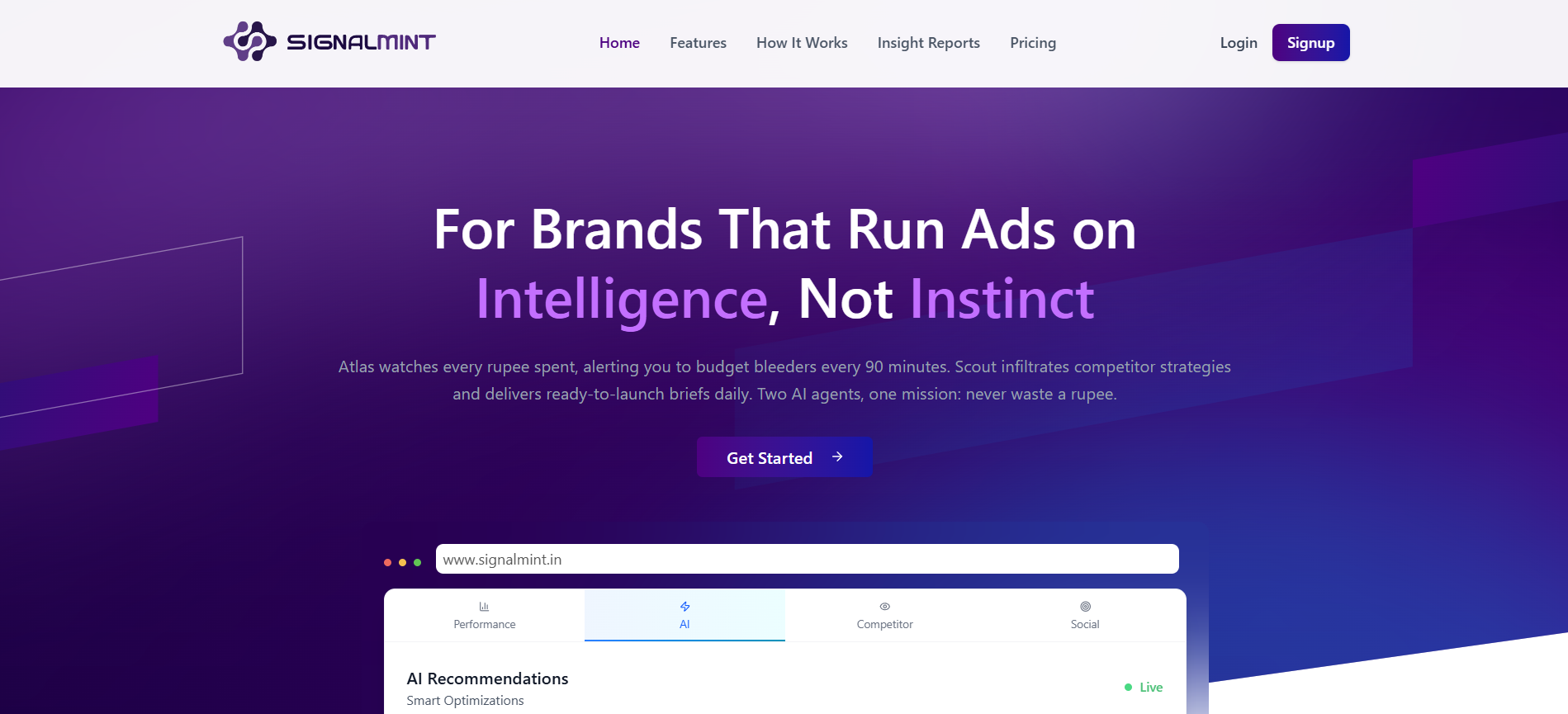
The Challenge: Decoding the Marketer's Vision
Every great product starts with a spark. For SignalMint, that spark came from a team of visionary marketers who felt a specific, burning pain point every single day: Strategic Blindness.
They knew their competitors were running profitable, high-scale ad campaigns. They could see the ads on their social feeds, but they had no way to reverse-engineer the success. They were flying blind, relying on instinct rather than data, while watching others scale. They approached Valnee with a bold vision but zero technical background.
Their ask was deceptively simple in words but massive in engineering scope:
"We want a platform that watches every move our competitors make, tells us what's working, and helps us replicate it instantly. And we need it fast."
They didn't have wireframes, database schemas, or a technical roadmap. They just had a problem. Our job shifted from being just "developers" to becoming Strategic Technical Partners. We had to listen to their plain-language struggles—"I hate taking screenshots of ads," "I wish I knew how long this ad has been running," "I don't know what to tell my video editor"—and translate those frustrations into a scalable software architecture.
The deadline? 21 Days. We set an audacious goal to ship a fully functional, production-ready MVP in just three weeks to capture a market window.
The Architecture: Engineering for Speed & Scale
To meet a 21-day deadline without building "technical debt" that would haunt us later, we needed a "No-Compromise" tech stack. We chose an architecture designed specifically for high-velocity data ingestion (scraping) and seamless real-time user interaction.
- Frontend: Next.js (React) We needed the application to feel like a native tool, not a clunky dashboard. Next.js gave us snappy page transitions, server-side rendering for speed, and a robust component system. This allowed us to build complex UI elements—like the interactive ad feed and real-time charts—without reinventing the wheel.
- Backend & Auth: Supabase Building a custom authentication system and database backend typically takes weeks. By using Supabase, we solved user management, database hosting, and real-time subscriptions in days. This allowed us to focus 90% of our engineering effort on the unique "Spy" features rather than boilerplate infrastructure.
- The Heavy Lifting: Python + Celery Scraping thousands of ads involves massive asynchronous processing. If we ran this on the main server, the dashboard would freeze. We built a robust Celery Priority Queue system. This meant that when a user requested a specific brand, that task jumped to the front of the line, ensuring the UI remained fast while the heavy lifting happened invisibly in the background.

The Evolution: Turning "Wants" into "Workflows"
We didn't just build a list of features; we built a complete intelligence workflow that mimics the thought process of a master marketer: Find, Analyze, Monitor, and Execute.
1. The "All-Seeing Eye" (Ad Discovery)
The first friction point was visibility. Marketers were wasting valuable hours manually clicking through Facebook Ad Libraries, taking screenshots, and saving links in messy spreadsheets. This manual process was slow, prone to error, and impossible to scale.
We built Ad Discovery, a centralized, searchable feed that ingests competitor ads in real-time. We engineered advanced filtering logic that allows users to slice data by Format (video vs. image), Platform, Industry, and Keywords. It turned a 4-hour manual research slog into a 4-second search query. Users could now see exactly what their competitors launched this morning, formatted in a clean, Pinterest-style grid.

2. Scout: The Automated Intelligence Engine
Searching is active work. Our client wanted passive intelligence. They asked, "Can the system just tell us who is winning so we don't have to look?" This was a pivotal moment where we moved from building a tool to building an Engine.
We developed Scout.
Scout is an automated background engine that monitors ad longevity. It operates on a simple but powerful premise: Profitability = Longevity. If a competitor keeps an ad running for 30+ days, it is making money. If they kill it in 3 days, it failed.
Scout automatically identifies these "Crown Winners" ads running for 30+ days with multiple active variants—and flags them for the user. This feature fundamentally changed the user behavior from "hunting" for ideas to "receiving" validated winners in their inbox.

3. Atlas: The Performance Watchdog
As the scope expanded, the client realized they needed to protect their own downside. While spying on competitors is valuable, monitoring your own financial health is critical. They needed a way to monitor their own ad health alongside their competitors.
We introduced Atlas, a high-level performance command center. Atlas connects directly to the user's ad accounts via API to visualize Spend, ROAS (Return on Ad Spend), and Anomalies. It acts as a financial guardrail, alerting users if a campaign is bleeding budget or if a scaling opportunity is being missed. By unifying "Spying" and "Managing" into one screen, we created a sticky daily habit for users.

4. Closing the Execution Gap: From Insight to Briefs
The biggest bottleneck in marketing isn't finding the idea; it's explaining it to the creative team. The handoff between the "Strategist" (who finds the insight) and the "Video Editor" (who makes the asset) is usually messy, involving long email threads and misinterpreted instructions.
To solve this, we built an Automated Briefing System.
Once a user finds a winning competitor ad via Scout, they can click one button to generate a structured Creative Brief. The system extracts the visual style, the script structure, and key hooks, formatting it perfectly for an editor. It bridged the gap between data and design, reducing the "briefing time" from 30 minutes to 30 seconds.

5. Instant Execution (Template Library)
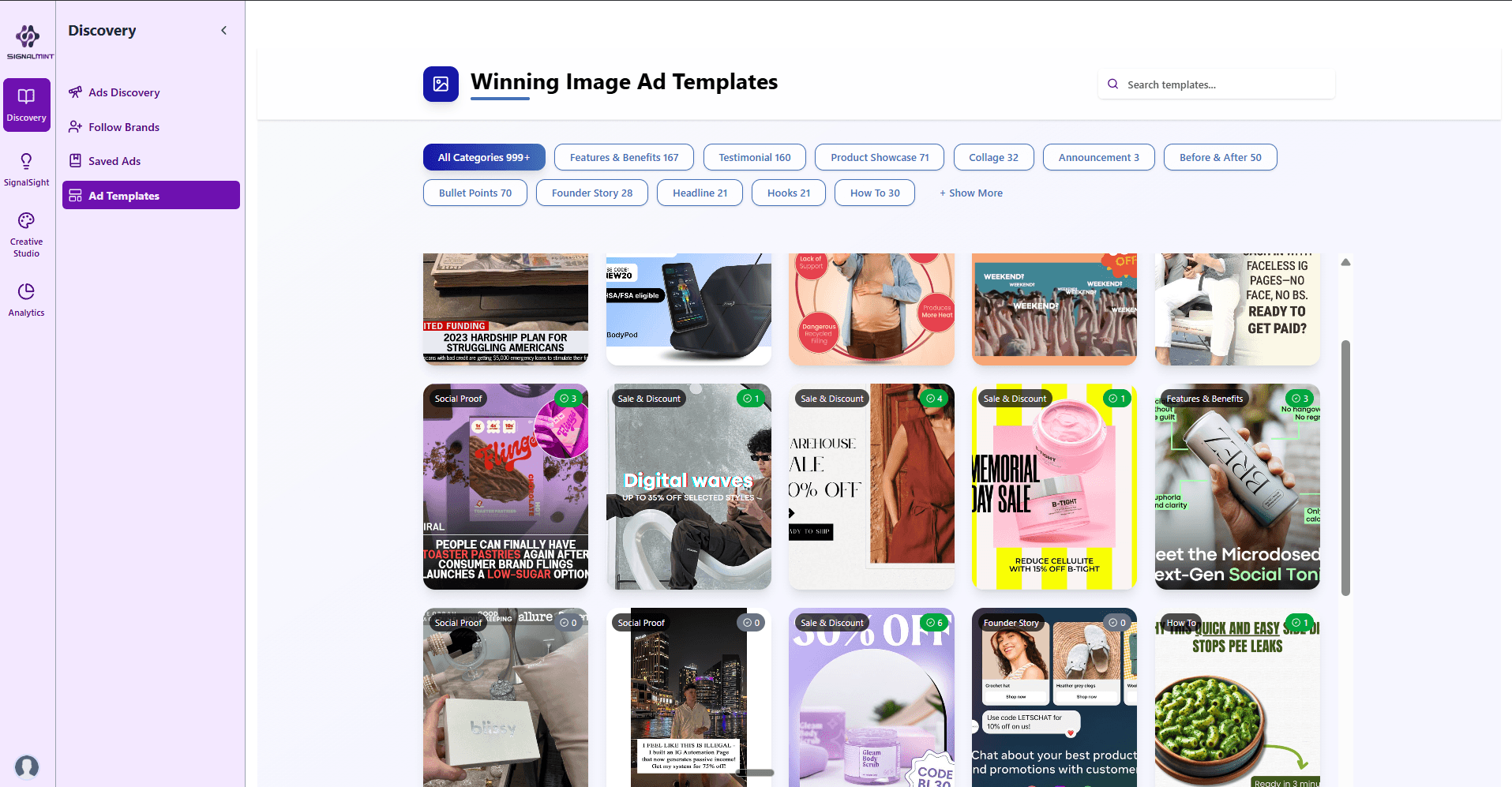
For smaller teams and solopreneurs who didn't have video editors, we went a step further. We analyzed the high-performing ads found by Scout and reverse-engineered them into Winning Ad Templates.
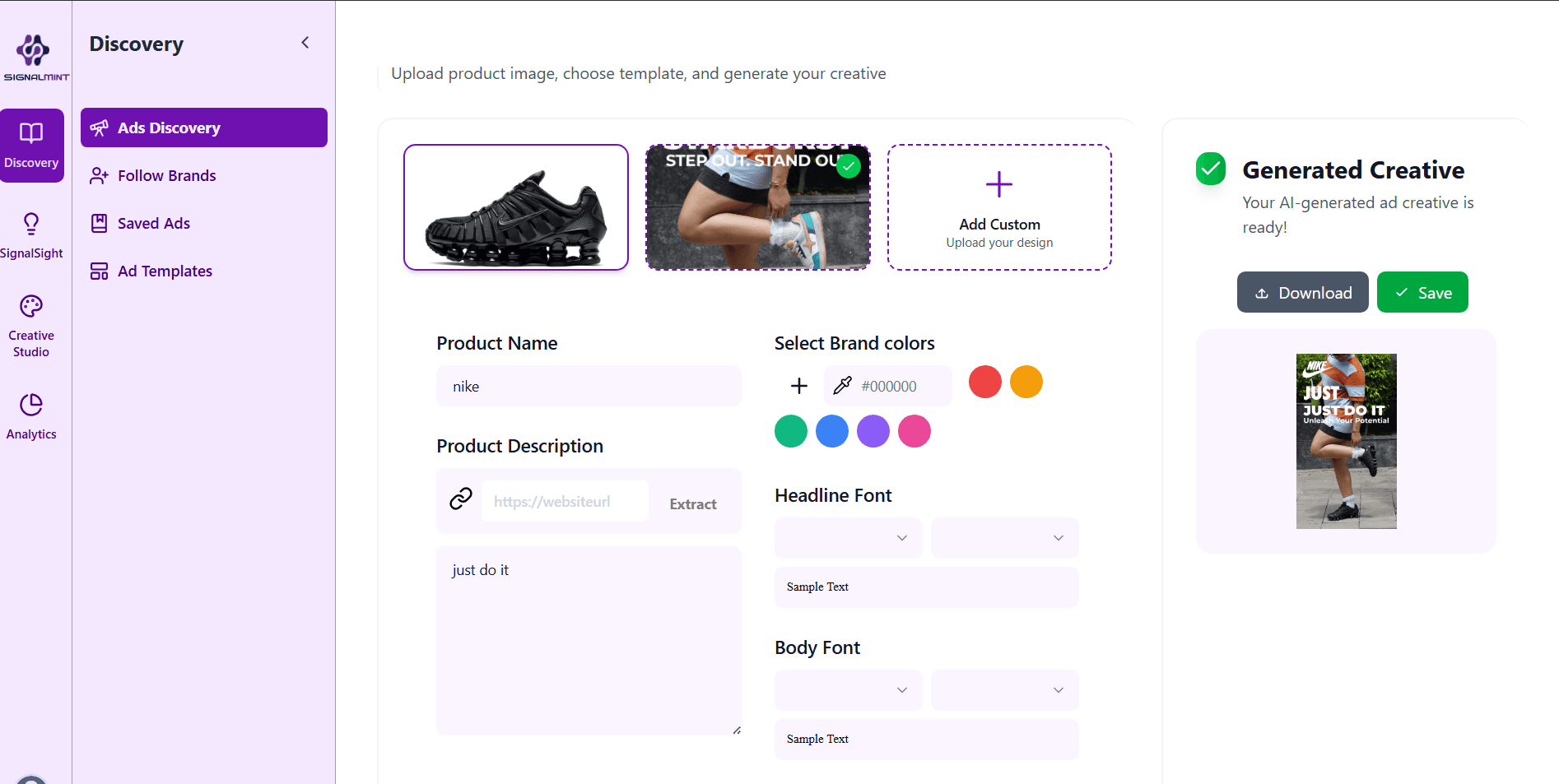
These are pre-built, conversion-optimized layouts. Users can simply select a template (like "User Testimonial," "Before & After," or "Feature Breakdown"), swap in their product image, and export a ready-to-launch ad. This feature democratized high-end ad creation, allowing a single founder to produce agency-level creative work in minutes.

Tracking What Matters (Internal Ops)
We didn't just build for the end-user; we built for the business owners.
To ensure the client understood how their tool was being used, we built a robust Admin Analytics Dashboard.
This internal view tracks critical health metrics:
- "How many briefs were generated today?" (Indicating engagement)
- "Which templates are most popular?" (Guiding future content strategy)
- "How is user retention trending?" (Monitoring business health)
This radical transparency allowed the non-technical founders to make data-driven product decisions without needing to ask engineers to query the database manually.

The Flow in Action
Here’s what happens behind the scenes when a user tracks a brand:
- A user requests a brand to be analyzed.
- The brand is added to the database.
- Scrapers collect ads → AI tags and analyzes them → insights are stored.
- A periodic beat refreshes the database so insights stay up to date.
For the user, the complexity is invisible. They type in a brand, and a living, dynamic intelligence hub appears.
Behind the Scenes
The road wasn’t entirely smooth. Halfway through development, we lost a key team member. On a project moving this quickly, that could have derailed momentum.
Instead, we reassigned tasks quickly, brought in a strong replacement hire, and managed the transition in stride. In the end, the new addition elevated the project further — proving that adaptability is just as important as speed.
Team Flow & Communication
Our approach to communication made all the difference:
- One point of contact for the client → They always had a representative who understood their needs and could translate them to the team.
- Trello Kanban system internally → Clear delegation, transparent progress, no blockers left unchecked.
- Plain-language feedback loops → Clients described ideas like “show ads side by side” and we turned that into polished features.
For non-technical clients, this was huge. They never had to “speak tech” we did the translation for them.
Tracking What Mattered
From day one, we included:
- Cost tracking → to keep resources efficient.
- Usage monitoring → so admins could see how features were being adopted.
This gave everyone clarity on performance and ROI.
The Outcome: A Business Built in 3 Weeks
The SignalMint project was a masterclass in Collaborative Velocity. By combining a clear (albeit non-technical) vision with Valnee's disciplined engineering execution, we achieved what many said was impossible.
- Velocity: We hit the 21-day MVP target, giving the client a real product to test immediately.
- Validation: The subsequent Cohort Test was a massive success—marketers, brands, and sales execs validated that the data was not just interesting, but actionable.
- Scalability: What started as a simple scraper idea evolved into a full "Marketing Intelligence Suite" comprising Scout, Atlas, and the Creative Studio.
This project proved that you don't need a technical founder to build a technical product—you just need a partner who can translate your vision into velocity.