
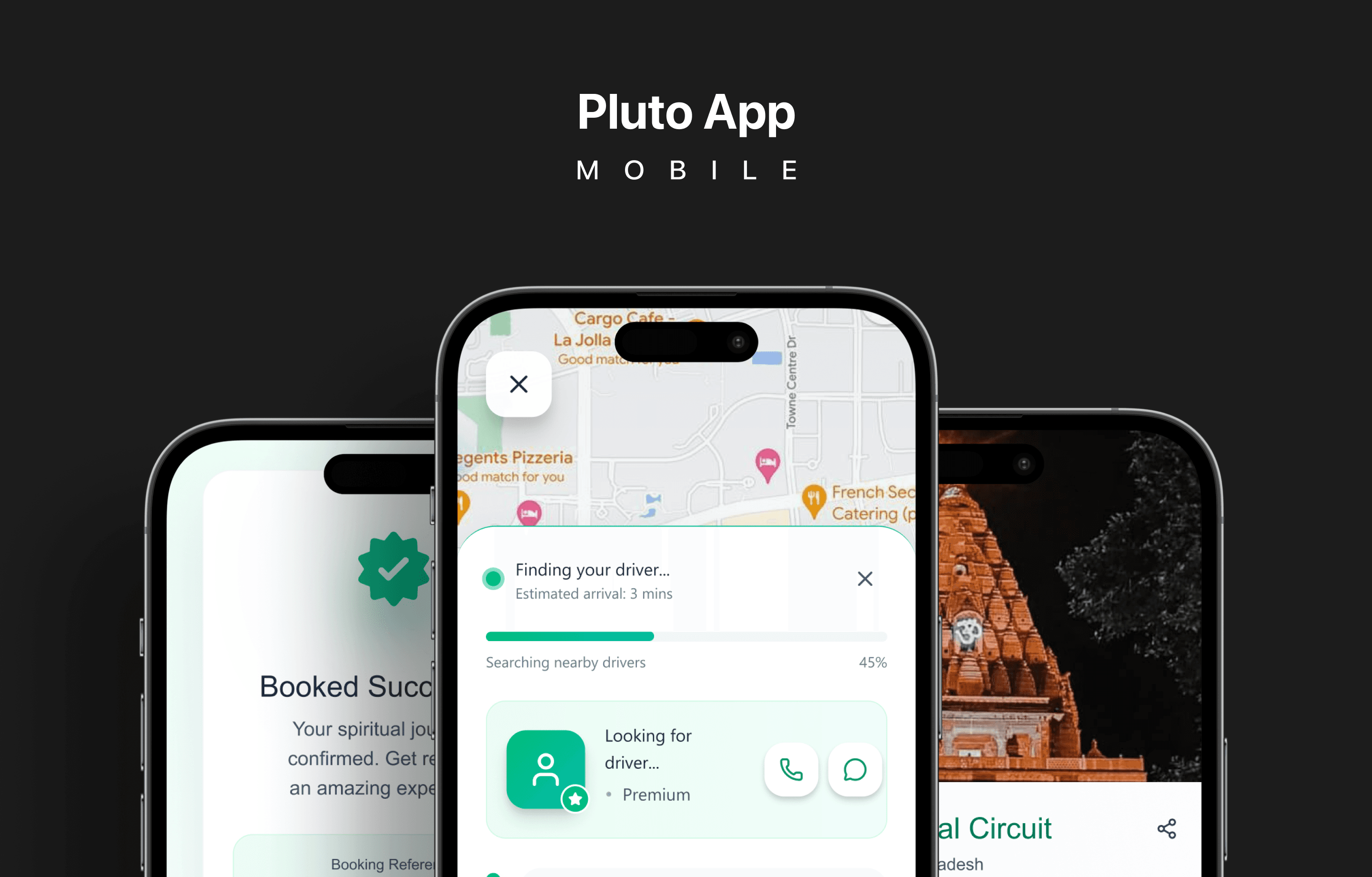
The "Uber for Pilgrims": How We Accidentally Built a Logistics Empire

I. The Hunger: "We Need a Win"
Every agency has "The Era of Silence." We were a young startup. Our portfolio was thin—just one lonely project sitting on the shelf. The air in the office was thick with the need for work. We didn't just want a client; we wanted a challenge.
Then, the phone rang.
It was a team of founders with a vision that sounded deceptively simple: "We want to digitize the spiritual journey."
They wanted an application for rural, high-traffic spiritual cities like Ujjain. The goal was to build a "Wikipedia for Newcomers"—a digital guide that would help pilgrims navigate famous temples, find hidden spots, and understand the history of the holy land.
We looked at the brief. We looked at our empty schedule. We said, "Let's build it."
II. The "Trojan Horse" Feature
We started Phase 1 with a clear roadmap: Content is King.
We designed a beautiful, content-rich interface. We chose a deep, trusting "Forest Green" palette—a color that signaled nature, spirituality, and calm.
- The "Temple Tech" Interface: We built structured "Packages". You didn't just visit a city; you booked a "Spiritual Circuit."
- The Itinerary Engine: We coded a dynamic timeline that mapped out your day: Mahakaleshwar at 8:00 AM -> Bada Ganesh at 10:00 AM. It was linear, clean, and informative.

But then, the client dropped a casual comment during a sprint review—a sentence that would change everything:
"It would be nice if they could also book a car to get between these temples, right?"
We nodded politely. "Sure, a booking form."
"And maybe track the driver? And pay via wallet? And rate the trip?"
We froze. They didn't want a booking form. They wanted us to build Uber.
III. The "Accidental" Super-App
Suddenly, we weren't building a guidebook anymore. We were building a Real-Time Logistics Engine.
The scope didn't just creep; it exploded. We expanded the architecture from a simple information app to a Three-Headed Hydra:
- The User App: For the pilgrim to book rides, view driver location, and manage itineraries.
- The Driver App: For the local taxi operator to accept rides, view earnings, and navigate.
- The "God Mode" Backend: A universal server to manage state, payments, fleet availability, and geolocation logic.

The "Green" Uber
We designed the "Pluto Wallet" and "Ride Tracking" modules. We integrated live socket connections to show the driver's car moving on the map in real-time.
- The Challenge: We had to sync the "Spiritual Tour" data with the "Taxi Logic."
- The Result: A seamless flow. You select "Ujjain Spiritual Tour", and the app automatically calculates the distance, the fare, and assigns a driver who knows that specific route. It was genius. It was Context-Aware Ride Sharing.

IV. The Reality Check: The "Analog" Barrier
Phase 2 was done. The app was beautiful. The tech stack—React Native on the front, Node.js on the back—was humming. We were ready to disrupt the spiritual tourism market.
We went to the field to test with the real users: The Drivers.
It was a disaster.
The local drivers in rural cities weren't tech-savvy Silicon Valley residents. They looked at our sleek, minimal "Accept Ride" screens and were confused. The fonts were too small. The flows were too complex. The language was English.
We had built a Ferrari for people who were used to riding bicycles.
V. The "Human" Patch
We realized that UX isn't about how it looks; it's about who uses it.
We went back to the code. We didn't add features; we stripped them.
- Localization Engine: We rewrote the app to support multiple local dialects and languages instantly.
- The "Big Button" UI: We increased touch targets by 200%. We replaced text with icons. We made the "Accept" button huge and green.
- Intuitive Flows: We mimicked the mental model of a traditional taxi stand. No "surge pricing" graphs—just simple, flat numbers.
The adoption rate spiked. We had bridged the digital divide.
VI. The Ghost in the Server
We were at the finish line. We had a working product that combined TripAdvisor's content with Uber's logistics, tailored for India's spiritual heartland.
But startups are fragile things.
Just as we prepared for the grand launch, the client's internal team began to wobble. The operational reality of managing hundreds of drivers, vehicles, and customer support tickets hit them. They realized that building the app was the easy part; building the business was the mountain.
They had commitments elsewhere. The passion faded. The emails slowed down.
We wrapped up the code. We handed over the keys to the repository. We closed the contract on good terms.
VII. The Legacy of Pluto
Today, Pluto sits in a digital vault. It is likely the most advanced, beautiful, and culturally tuned spiritual tourism app that nobody is using.
What We Learned:
- Scope Creep is a Silent Killer: A "feature" can turn into a "pivot" overnight. Be ready.
- Know Your User: A sleek UI means nothing if the driver can't read the "Accept" button.
- The Code Doesn't Care: We built a Lamborghini. It doesn't matter if it stays in the garage; we know the engine purrs.
Pluto was the project that taught us that we could build anything—even if the world wasn't quite ready to use it.