
The Initiative: "Eating Our Own Dog Food"
They say the cobbler’s children have no shoes. At Valnee, we realized a similar irony: we were building Ferraris for our clients, but driving a sedan ourselves.
Our internal SEO workflow had become a bottleneck of operational inefficiency. It was a classic case of "tool fatigue": on any given Friday, our marketing lead was toggling between a link checker, a speed test, and a keyword tracker, while our developers were manually running Lighthouse audits in the console. We were paying for five different SaaS subscriptions only to get a fragmented, blurry picture of our own digital health.
The frustration wasn't just about lost time; it was about lost standards. We realized that if we tolerated this friction internally, we weren't pushing our own boundaries.
The decision was binary: Stop complaining and start engineering.
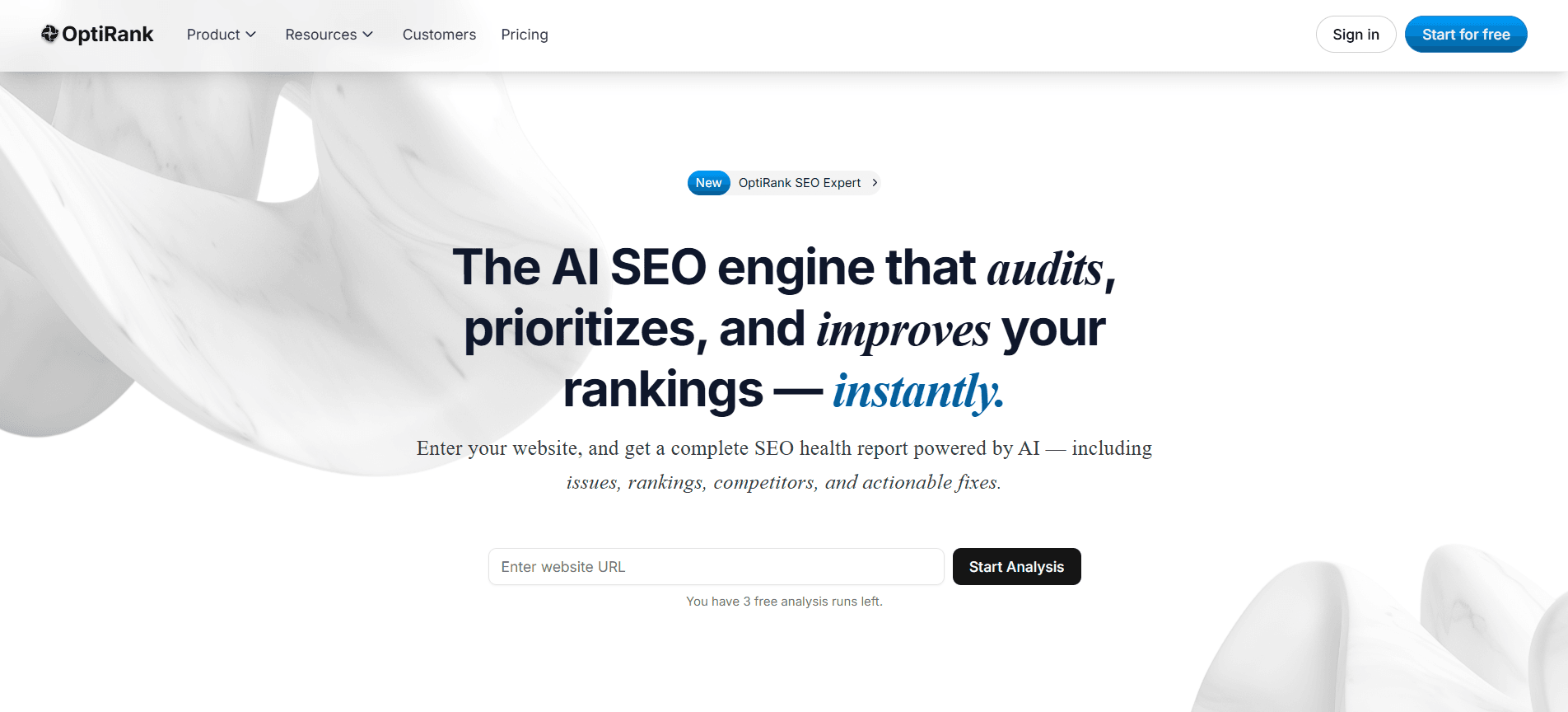
We decided to treat Valnee as our most demanding client. The goal was to build OptiRank—not just another SEO tool, but a centralized "Command Center" that would force us to "eat our own dog food." We knew that if we built a tool powerful enough to satisfy our own engineering team, it would serve as the ultimate "Gold Standard" architectural template for every future product we launch.
The Foundation: Building the "Ferrari" of MVPs
This wasn't a client project with budget constraints or legacy code integration. This was ours. That meant we had zero excuses to use anything but the absolute best technology available.
We treated OptiRank as a proving ground for the "Bleeding Edge" Stack:
-
Core Framework: Next.js 15 (App Router) We leveraged React Server Components (RSC) to reduce client-side bundle size, ensuring near-instant page loads and superior SEO fundamentals out of the box.
-
Database: Supabase (PostgreSQL) We needed the reliability of SQL with the speed of a Backend-as-a-Service. Supabase provided real-time subscriptions and built-in Auth, saving weeks of backend development time.
-
Security: Row Level Security (RLS) We adopted a "Zero Trust" architecture. Security logic is baked directly into the database, ensuring data isolation is mathematically enforced at the deepest layer.
-
UI Architecture: Tailwind CSS v4 + shadcn/ui By using headless primitives and the latest Tailwind engine, we achieved a fully accessible, dark-mode-ready interface that performs consistently across all devices.

The Evolution: How Needs Turned Into Features
As we started building, the features didn't come from a requirement document; they popped up from our daily struggles.
1. The "AI Awakening" (Solving for the Future)
Midway through development, we realized we were optimizing for Google 2020, not the AI-driven web of 2026. Traditional SEO tools check for keywords, but they don't check if ChatGPT or Perplexity can read your site.
We pivoted. We built a custom AI Readiness Engine.
It doesn't just look for meta tags; it scans our
llms.txt, analyzes semantic HTML structure, and checks content readability. Now, before we deploy, we know exactly how "machine-readable" our content is.
2. The "Performance Anxiety" Fix
"Why is the landing page feeling sluggish?"
This question used to trigger a 30-minute investigation involving three different browser extensions. We hated that.
So, we integrated Google Lighthouse directly into our dashboard. No more external tools. One click, and we get a live breakdown of our Core Web Vitals—LCP, Accessibility, and SEO scores. If a developer introduces a heavy image that kills load time, we see the score drop immediately in the Health Dashboard.

3. The "Spyglass" Strategy
We knew our competitors were moving fast, but tracking them was manual work. We wanted to automate our curiosity.
We built the Competitor Comparison module.
The idea was simple: "I want to paste a URL and see exactly what they are doing better than me."
Now, we can auto-fetch competitor metadata, compare word counts, and see gaps in their strategy side-by-side with ours. It turned "guessing" into "benchmarking."
-1.png%3Ftoken%3DeyJraWQiOiJzdG9yYWdlLXVybC1zaWduaW5nLWtleV9mM2QzNWI2Mi04YjZlLTRhZjQtYTg0Ny1iMjZhYWY3OGU4NmEiLCJhbGciOiJIUzI1NiJ9.eyJ1cmwiOiJuZXdfYmxvZ3MvU2NyZWVuc2hvdCAoNDE1KS0xLnBuZyIsImlhdCI6MTc2ODU0ODkyNSwiZXhwIjoxODAwMDg0OTI1fQ.X8WnxRjQCD5cPWlknHjDeAP8J9NwddgQUUPPDzUKRhQ&w=3840&q=75)
4. The "Did We Break It?" Monitor
The scariest part of rapid development is regression—fixing one thing and breaking another. We needed a paper trail.
We built a Recent Runs & Audit Log. Every time the engine crawls our site, it stamps the result. "Success" or "Failed."
This simple visual feed became our safety net. If we see a "Failed" tag at 1:51 AM, we know exactly which deployment caused it.

5. Monetization Ready
Although initially internal, we built OptiRank to be "business-ready" from day one. We integrated a hybrid payment system using Stripe and Razorpay, complete with webhook handlers. This ensures that if we ever decide to flip the switch and open this to the public, the infrastructure is already profitable.

Secure by Design (The Hidden Feature)
Since this tool would hold sensitive data about our strategies (and eventually our clients'), security couldn't be an afterthought.
We leveraged Supabase Auth and Row Level Security (RLS).
Even though it's an internal tool, we locked it down like a bank vault. Every query is verified at the database level. This means even if a frontend bug exposed an API endpoint, the database would simply refuse to serve data to an unauthorized user.

The "Dog Food" Dividend
OptiRank started as a way to stop using spreadsheets. It ended up becoming the most important tool in our arsenal.
By building it ourselves, we didn't just solve an SEO problem; we created a SaaS MVP Template that has reduced our setup time for new client projects by 70%. We proved that with the right architecture, you don't have to choose between speed and stability.
We aren't just guessing about our SEO anymore. We are engineering it.
And the best part? We’re just getting started.