
The Challenge: Escaping the "GPT Slop" Era
The AI boom brought a tidal wave of content, but let’s be honest: 99% of it was garbage. It was robotic, generic, and soulless. You could spot a ChatGPT-generated LinkedIn post from a mile away—it used words like "delve," "tapestry," and "landscape," carrying the personality of a cardboard box.
At Valnee, we didn't want a tool that could write. We wanted a tool that could mimic.
We faced a critical engineering question:
"Can we build an AI that doesn't just generate text, but actually inherits the soul, wit, and cadence of its user?"
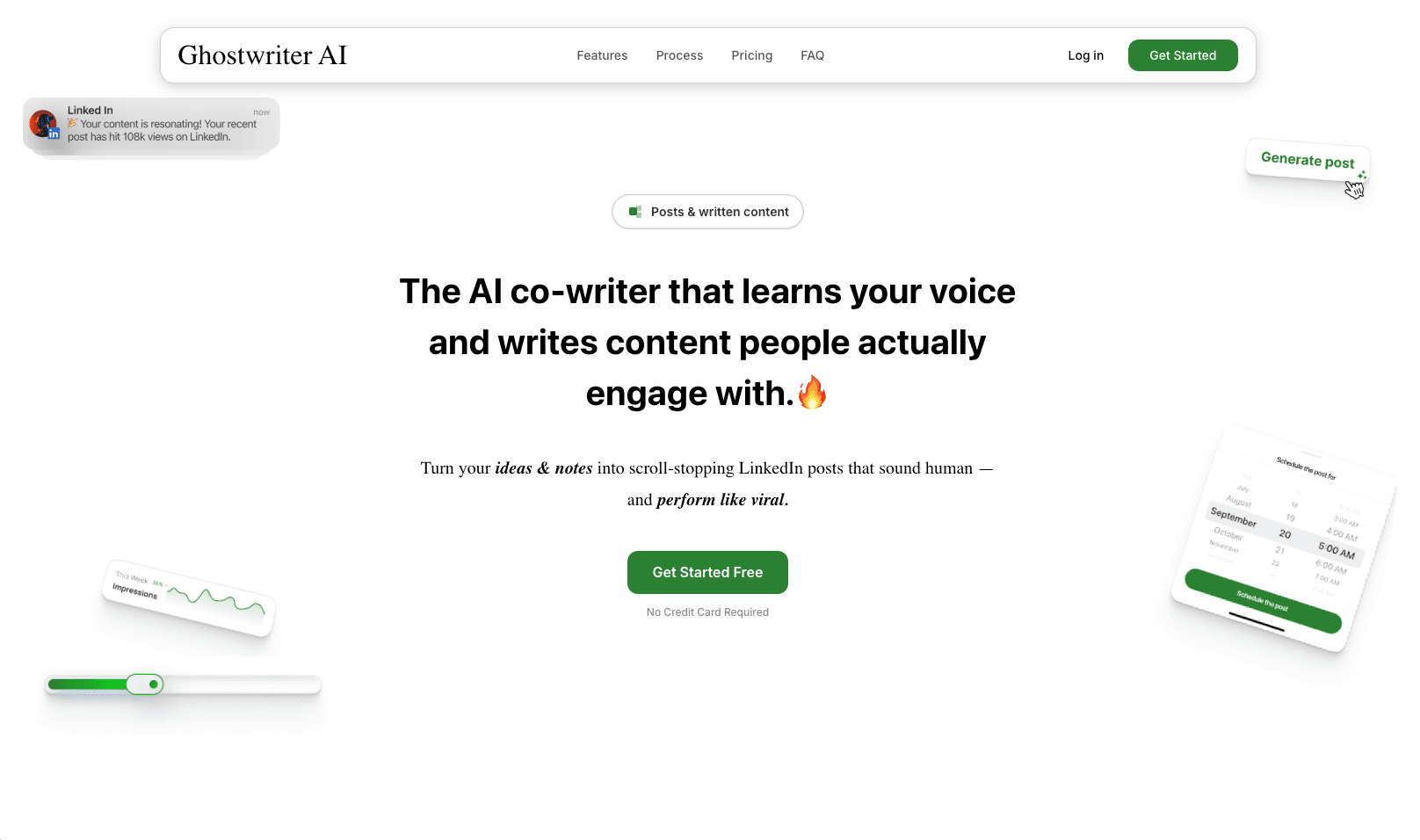
We weren't interested in building another thin API wrapper. We set out to build GhostWriterAI—a production-grade engine designed to clone your creative voice and automate your entire digital existence in 60 minutes a week.
The Architecture: A "Second Brain" for Creators
We needed a tech stack that could handle massive multi-modal inputs (voice, video, text) and turn them into polished assets instantly. We couldn't afford latency, and we couldn't afford insecurity.
- The Brain: Custom AI pipelines tuned for "Style Transfer." We didn't just prompt the model; we conditioned it.
- The Backbone: Supabase. We leveraged Supabase for handling massive context windows of user data securely. The vector embeddings required for "memory" needed a robust database that could scale infinitely.
- The Wallet: Razorpay integration baked in. This wasn't a hobby project; it was built to monetize from Day 1.

The "Superpower" Features
We stripped away the boring stuff found in standard writing tools and built features that felt like magic. We focused on the entire lifecycle of a creator: Context, Reference, Creation, and Visuals.
1. Context is King (The Memory Vault)
AI usually has the memory of a goldfish. Every time you open a new chat, you have to explain who you are, what you sell, and who your audience is. That friction kills flow.
GhostWriterAI remembers everything.
We built the Context Vault.
Users can save their "Persona DNA" directly into the system.
- Target Audience: Who are we talking to?
- Personal Bio: What is your backstory?
- Products/Services: What are we selling?
When a hot topic drops, you don't need to explain your stance again. You just point the engine at the news, and it generates a take that aligns with your history, your tone, and your business goals.

2. The Omni-Input (Turn Anything into Content)
Great ideas don't always happen at a keyboard. They happen in the shower, on a drive, or while watching a YouTube video. The problem is transferring that inspiration into a post.
We built the Omni-Input Engine.
Users can throw anything at it to serve as a reference:
- A messy 3-minute Voice Note rant.
- A URL to a 2-hour YouTube Podcast.
- A link to a dense Article or Blog.
- A raw Image.
The system digests the source material, extracts the gold, and transmutes it into a polished LinkedIn post in seconds. It’s alchemy for content. You provide the signal; the AI provides the noise.

3. The Chameleon Engine (Voice Cloning)
Most AI sounds like a robot. GhostWriterAI sounds like you—or anyone you want to be.
We built a Style Adaptation Layer. Users can feed the system their previous best-performing posts, and the AI analyzes the syntax, humor, sentence length, and emoji usage.
- Want to sound like yourself? Done.
- Want to write a thread in the style of Elon Musk or a stoic philosopher? Just toggle the "Persona" switch.
It’s not just writing; it’s method acting. The interface allows for rapid iteration—generating variations, expanding points, or shortening hooks with a single click.

4. Visual Intelligence (Generative Art)
A wall of text is boring. To win on social media, you need visuals. But jumping between ChatGPT for text and Midjourney for images breaks the flow.
We integrated Image Generation directly into the writing workflow.
The AI reads the post it just wrote, understands the context/hook, and generates a relevant, high-quality image to accompany it. No prompting required. It matches the "vibe" of the text automatically.

5. The Carousel Factory
LinkedIn Carousels get 10x the reach of standard posts, but they typically take 4 hours to design in Canva or Figma. That is a massive friction point.
We fixed that. We built a One-Click Carousel Generator.
Users feed it a topic or a thread, and the engine spits out a perfectly designed, swipeable PDF carousel. It handles the typography, the brand colors, the layout, and the flow. What used to take a design team an entire afternoon now takes a button click.

Product Choices That Paid Off
Our MVP template set the stage, but these specific choices were crucial for a content platform:
- Supabase: Provided reliable real-time updates, authentication, and role-based access without complex backend setup.
- Razorpay: Integrating plan-based subscription management from the start made the path to monetization clear and immediate.
- Codebase Modularity: The clean separation between core logic, integrations, and UI layers (thanks to the template) made it easy to maintain and scale.
Behind the Scenes: Navigating Challenges
Even with a strong foundation, we faced constraints. The main challenges were:
- Balancing Scope vs. Resources: With a small core team, we had to be ruthless in prioritizing high-impact features for the MVP.
- Integration Consistency: Ensuring Supabase, Razorpay, and the frontend state management worked smoothly without dependency conflicts.
- Performance Optimization: AI applications demand efficient handling of API responses. We carefully optimized our data flows to ensure the UI felt fast and responsive.
Our structured, task-based approach and continuous internal testing helped us mitigate these challenges early.
The Outcome
GhostWriterAI transformed from an internal experiment into a "Content Operating System."
- Radical Efficiency: What used to take a creator 20 hours a week (writing, designing, scheduling) now takes 90 minutes. We turned a daily grind into a "Monday Morning Coffee" task.
- Authenticity at Scale: By solving the "robotic voice" problem, we built a tool that creators actually trust with their personal brand.
- Business-Ready: With authentication and payments running on the MVP template, it wasn't just a toy; it was a scalable SaaS product from the moment we wrote the first line of code.
We didn't just build an AI writer. We built a force multiplier for human creativity.