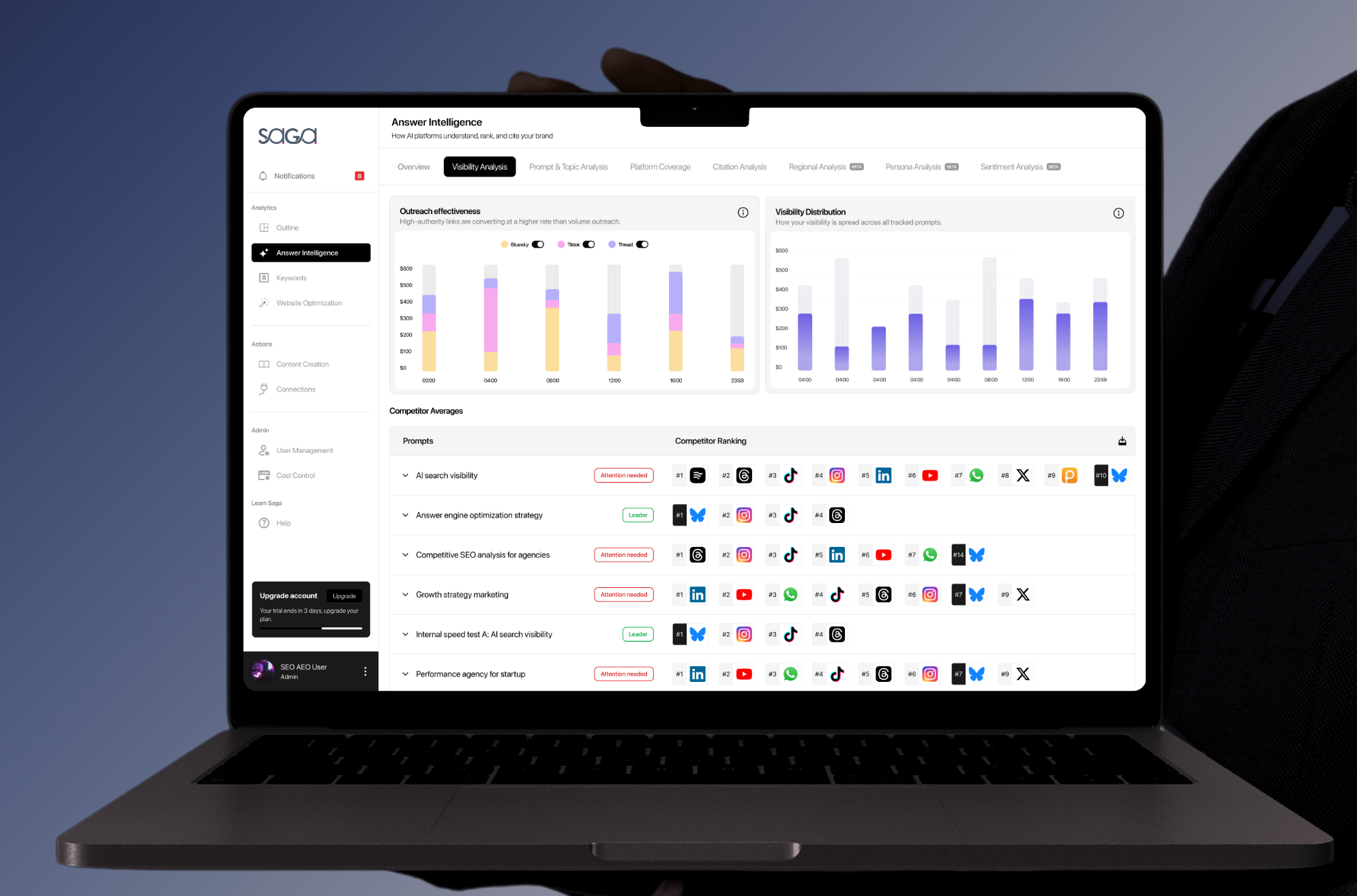
SagaAI - Engineering a Unified Search & AI Visibility Platform
 The central workspace: monitoring domain health, tracked prompts, citation frequency, and crawler diagnostics in one place.
A quick backstory
For years, search strategy was straightforward: optimize metadata, build links, and track rankings across search engine result pages.
However, user search habits have fundamentally shifted. High-intent queries are increasingly answered directly by generative AI answer engines like ChatGPT, Perplexity, Claude, and Gemini. If an AI engine answers a prospect’s query and recommends competitor products while omitting your brand, you lose that customer before they ever visit a website.
The goal with SagaAI (reachsaga.com) was simple: build a unified platform that bridges classical Technical SEO with modern Answer Engine Optimization (AEO). The client needed a centralized tool that gives growth teams visibility into where they stand in generative answers and provides the workflows to fix visibility gaps directly.
The core engineering challenges
Building an enterprise platform that monitors both web crawlers and non-deterministic AI models introduced several complex development hurdles:
- The lack of visibility in AI search: Traditional analytics platforms only measure deterministic clicks and page rankings. They cannot track how often probabilistic language models cite a brand or which third-party sources the models pull into their context windows.
- Synchronous processing bottlenecks: Scraping real-time search engine results and evaluating multi-second AI inference responses on the primary application thread caused frequent request timeouts and 504 errors.
- Aggressive bot rate limits & crawl budgets: AI crawlers operate with strict timeout thresholds. Websites with bloated DOM trees, render-blocking scripts, or malformed semantic tags were being skipped during model retrieval passes.
- Pipeline reliability under high concurrency: Orchestrating automated site audits, schema generations, and high-frequency SERP scraping concurrently without hitting external API rate walls or dropping jobs.
What actually shipped
- A unified intelligence dashboard: Consolidates traditional organic health indicators and real-time AI citation tracking into a single view.
- Answer intelligence & citation gap analysis: Automated prompt testing across major AI models to identify queries where competitors are cited instead of the client.
- Structured AEO content engine: An in-app creation studio that formats informational copy for model retrieval and automatically injects compliant JSON-LD microdata.
- Technical website deep dive & page readiness audits: Automated diagnostics that inspect bot accessibility, DOM hierarchy, and schema validity before pages go live.
- Integrated authority outreach workflows: Tools to identify citation sources and execute relationship outreach to authoritative third-party publishers.
- Decoupled asynchronous worker architecture: An isolated background processing pipeline that executes heavy compute and scraping tasks reliably without blocking the UI.
The user flow
- Configure domain and prompt matrices: Input target domains, competitor benchmarks, and high-intent industry queries.
- Evaluate citation share of voice: Analyze how frequently the brand is recommended across leading AI models compared to competitors.
- Trace grounding sources: Identify the specific third-party reviews, directories, and articles that AI engines pull as authoritative references.
- Audit technical crawlability: Run deep-dive scans to identify semantic tag errors, slow scripts, or missing structured data.
- Draft and validate structured content: Generate dense, factual content blocks with automated schema markup verified via pre-flight readiness checks.
- Acquire high-authority mentions: Use built-in outreach tools to connect with publishers that AI engines actively cite.
1. Mission Control: Outline Dashboard
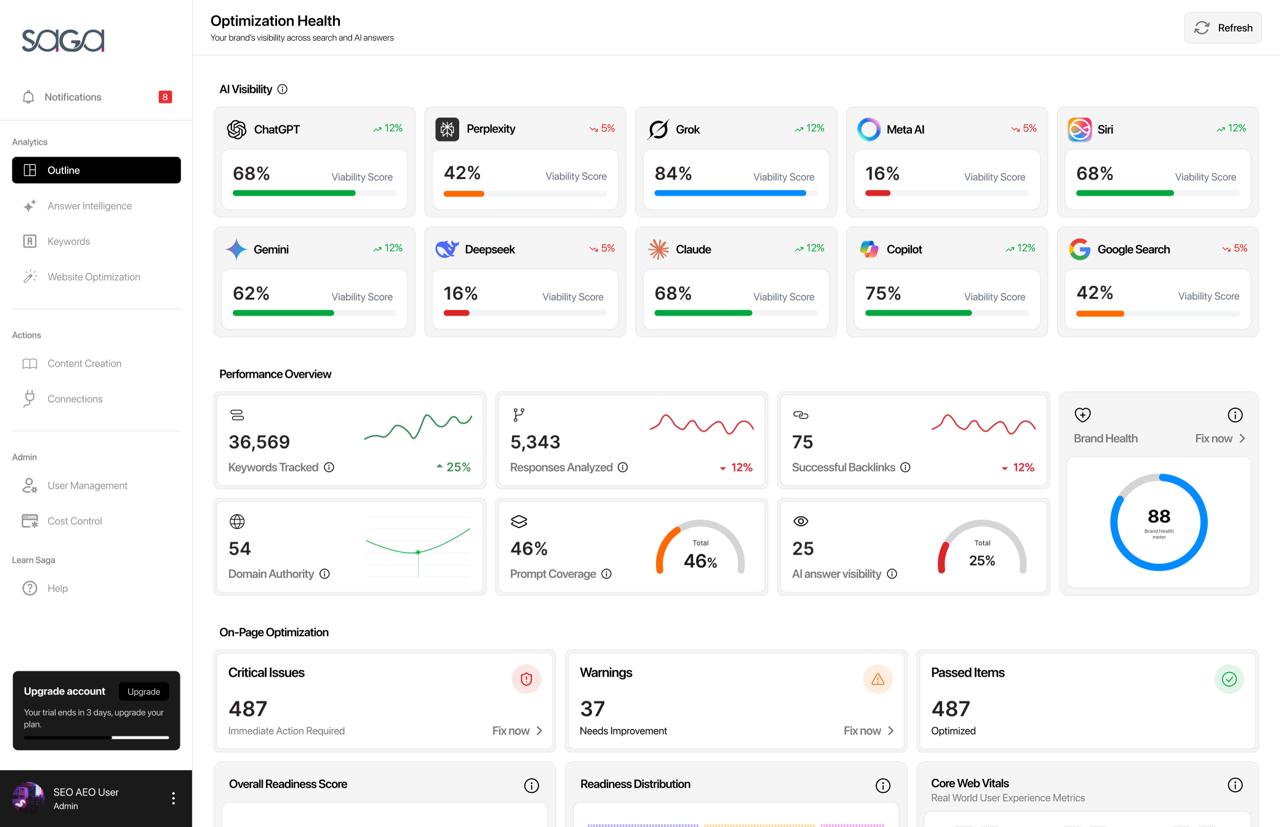
Brings together core search metrics and AI visibility trends into a single overview, eliminating the need to jump between multiple disjointed SEO tools and manual prompt tests.
Central dashboard displaying citation frequency, overall search health, and active prompt monitoring.
2. Answer Intelligence & Visibility Analysis
Surfaces brand presence across leading answer engines, pinpointing the exact prompts where competitors are cited and revealing the third-party sources behind each recommendation.
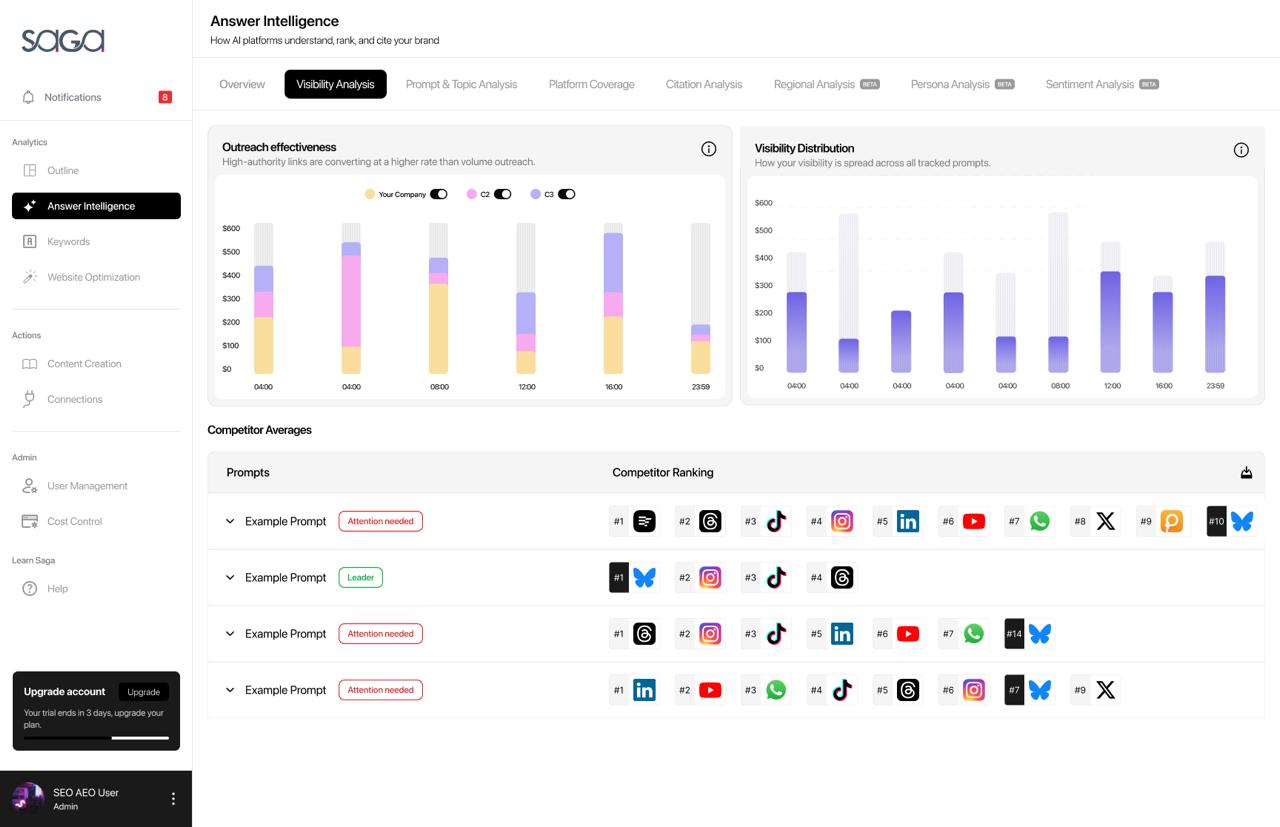 Comparative visibility metrics detailing AI share of voice and source attributions.
3. Content Creation Studio
A purpose-built workspace designed to generate high-density, factual content structured for machine retrieval and automated schema compliance.
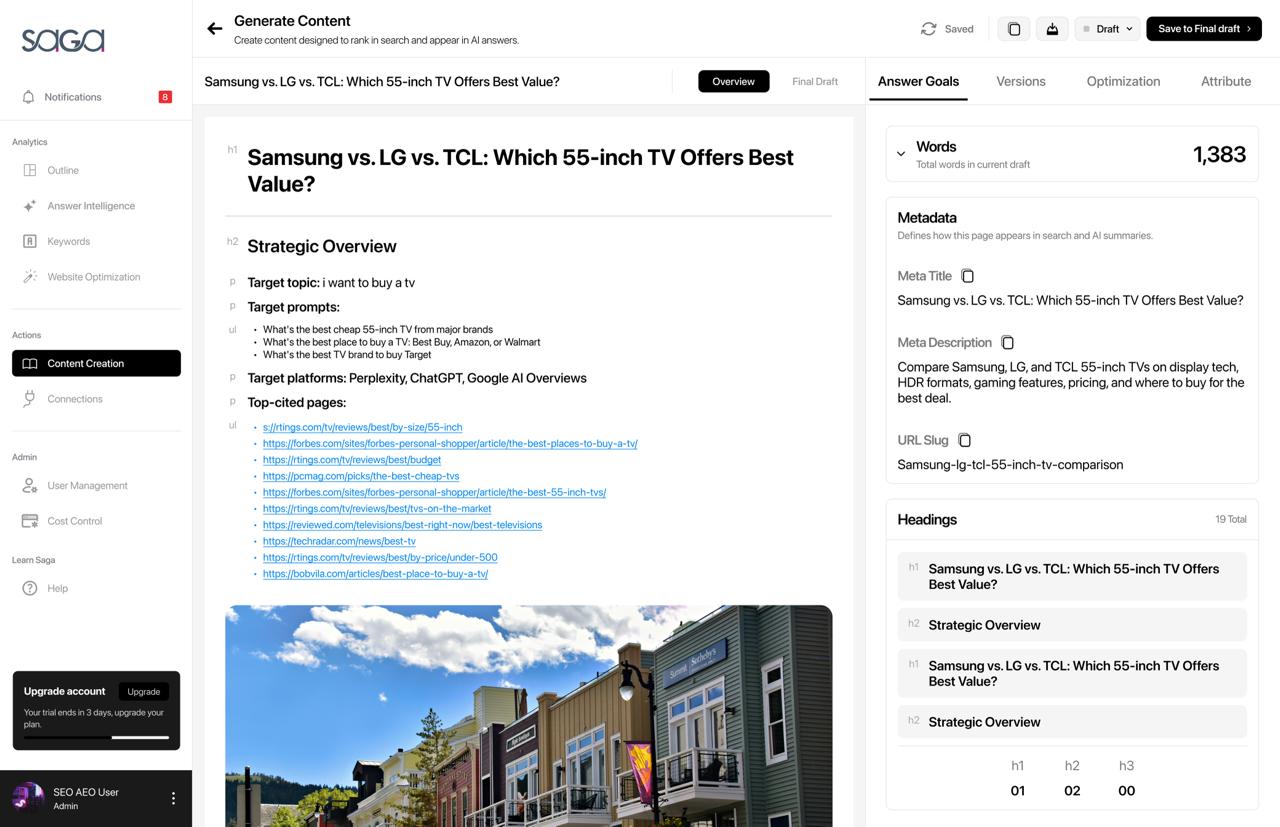 Generating structured copy, contextual media briefs, and automated JSON-LD microdata.
4. Technical Website Optimization Deep Dive
A comprehensive diagnostic scan that reviews the technical factors AI crawlers require: quick response times, clean DOM hierarchies, and unblocked server responses.
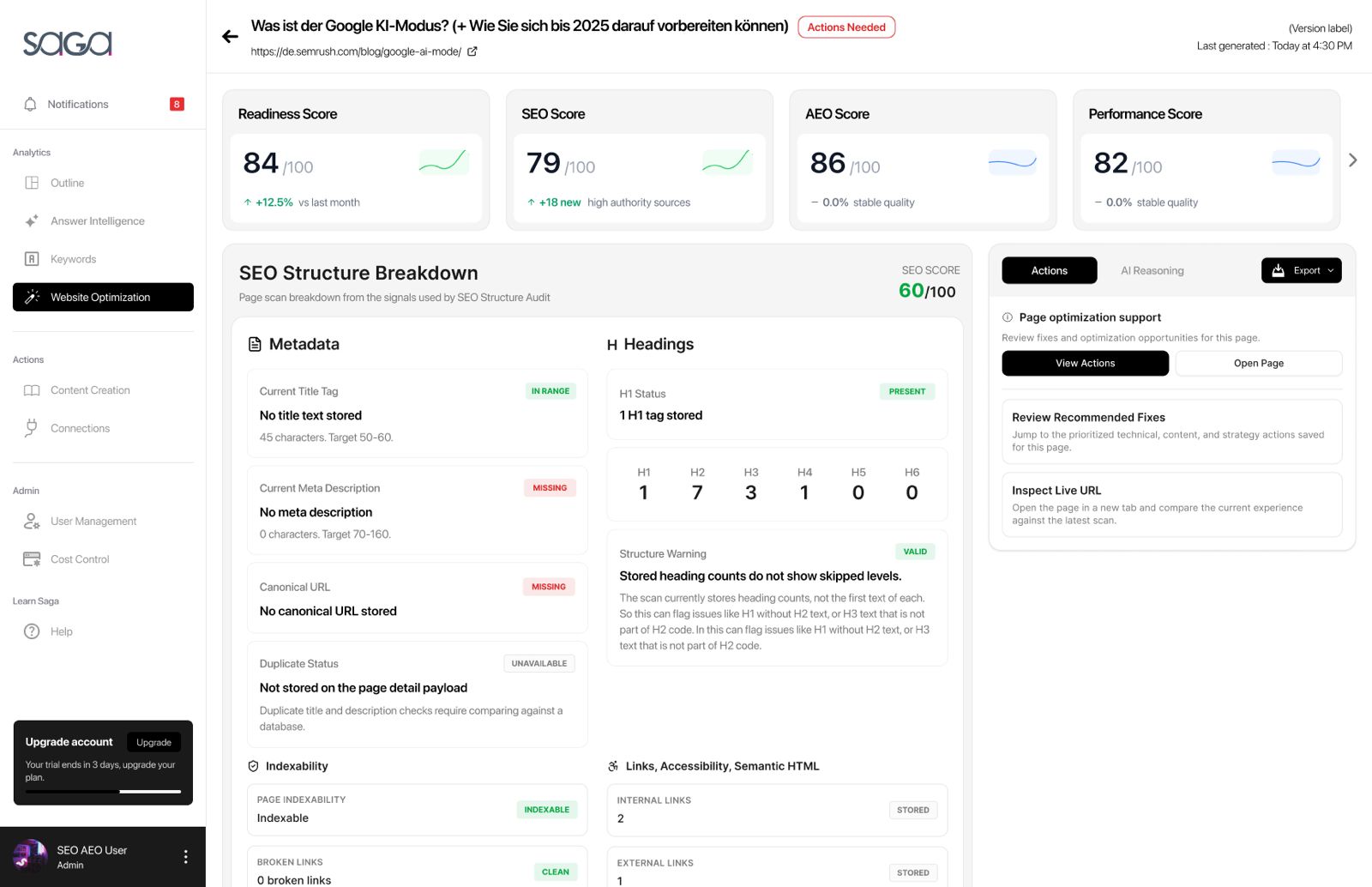 In-depth diagnostics inspecting semantic markup, crawl efficiency, and Core Web Vitals.
5. Page Readiness Summary
A pre-flight verification gate that validates new pages and schemas before publication to prevent technical penalties or crawl errors.
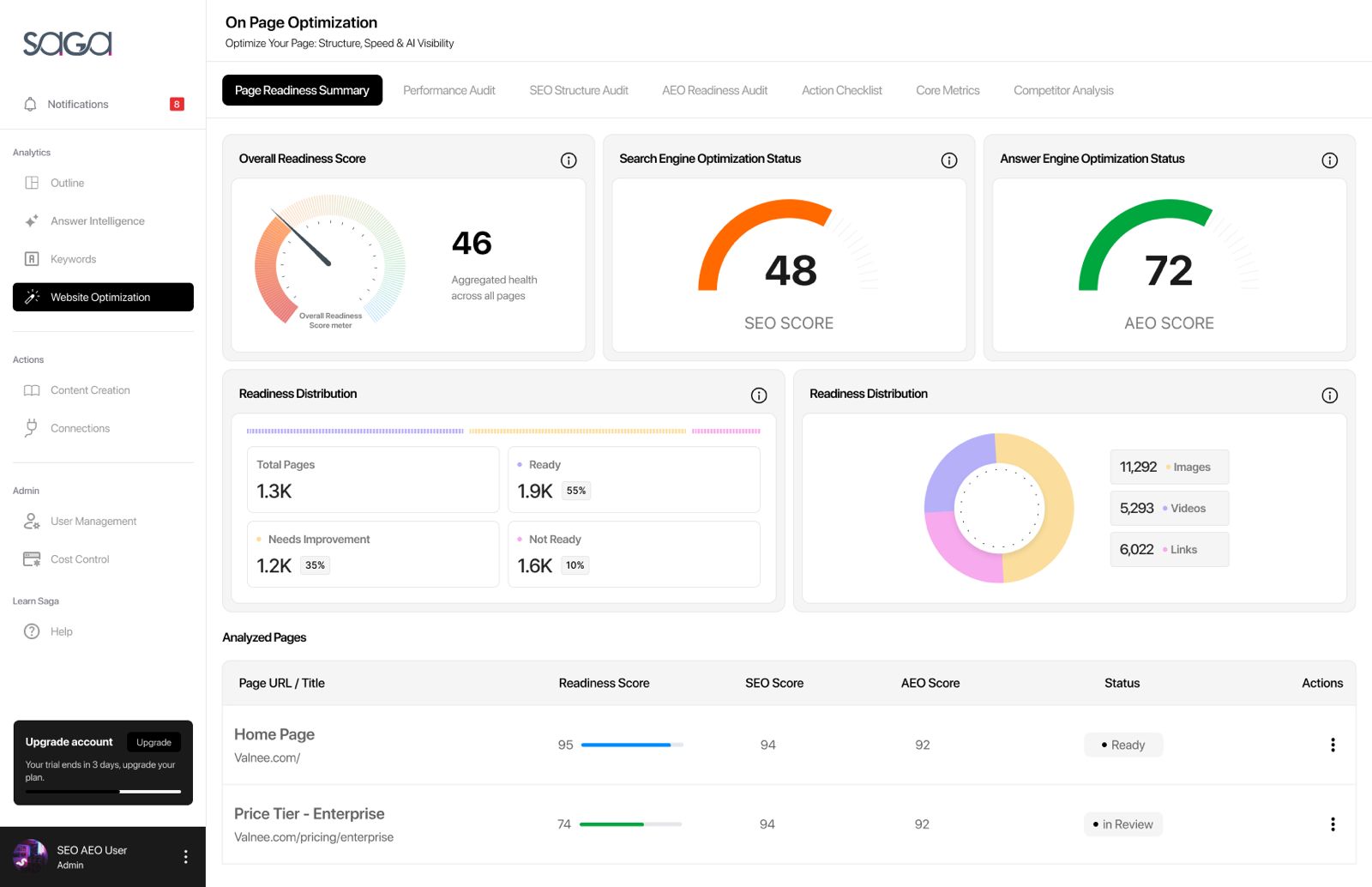 Pre-flight validation ensuring schema integrity, entity clarity, and crawl compliance.
6. Authority & Outreach Execution
An integrated outreach workflow to discover external domains that AI answer engines currently reference and coordinate link acquisition campaigns.
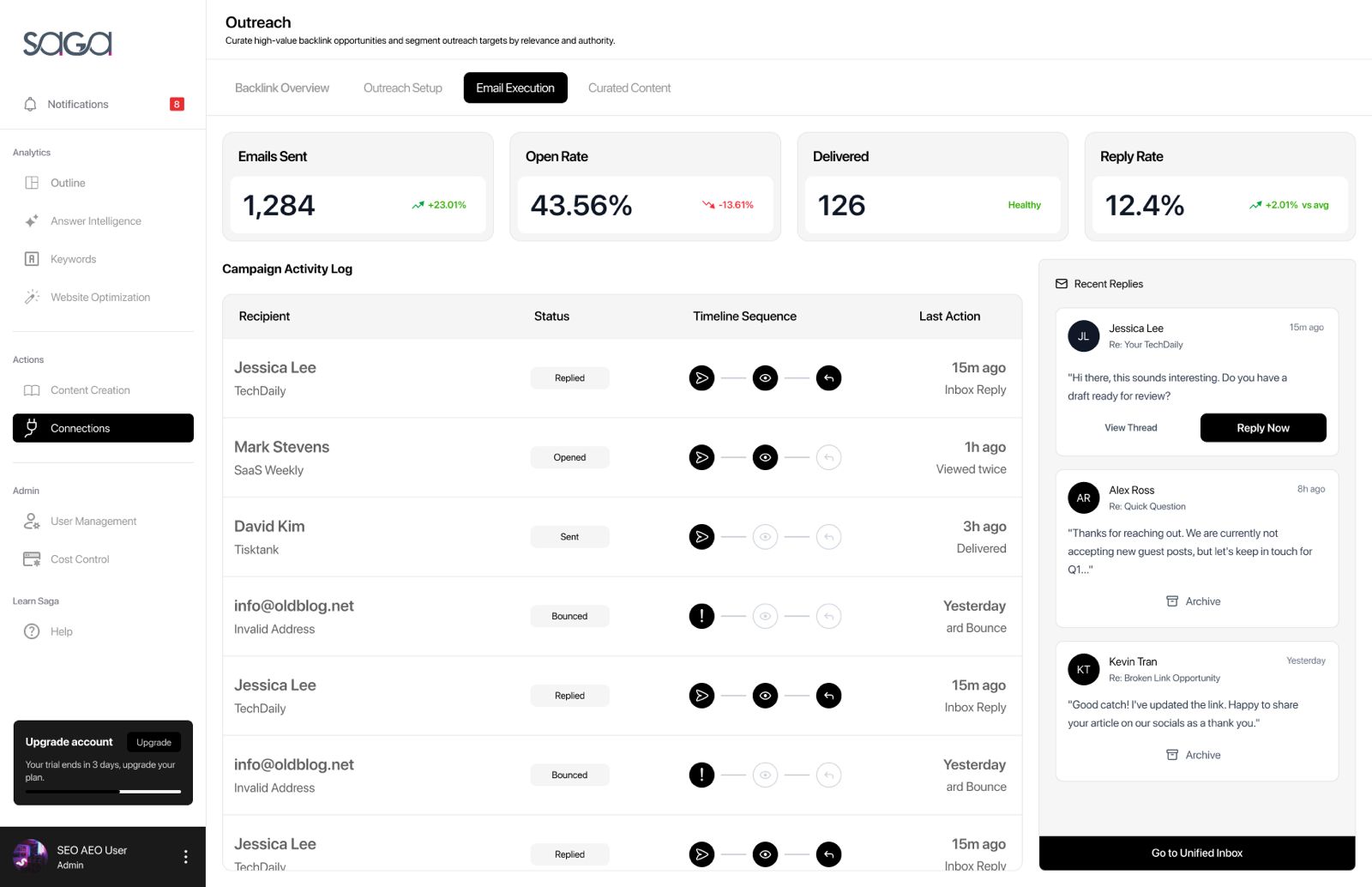 Managing publisher relationships and citation outreach directly within the platform.
Behind the scenes: How we engineered it
1. Decoupling the compute layer
- Asynchronous task execution: Rather than executing heavy SERP extraction and LLM inference calls synchronously on user requests, we separated compute into dedicated background workers.
- Abstracted queue architecture: Engineered a queue layer that runs local dispatch during development and switches automatically to a distributed cloud queue with automatic retries and concurrency control in production.
- Non-blocking user interface: Long-running scraping and audit tasks execute in the background while users navigate the dashboard freely, with status updating dynamically upon task completion.
2. Rate limiting & fault tolerance
- Traffic smoothing: Implemented concurrency queues to pace requests to external APIs and web scrapers, eliminating IP bans and rate-limit errors.
- Automated retries with backoff: If a target website or model endpoint is temporarily unresponsive, the job automatically re-queues with exponential backoff rather than failing the entire audit.
- Granular audit logs: Every scraping pass and prompt test is tracked with state logs, making unexpected edge cases easy to inspect and debug.
3. Data integrity & state management
- Structured relational models: Built a clean relational database architecture isolating organization workspaces, credit budgets, crawl snapshots, and prompt histories.
- Server-side payload hygiene: Optimized server-rendered views to deliver rich analytics dashboards without transferring heavy JavaScript bundles to the browser.
Outcome
Over a 90-day evaluation period across enterprise workloads, the re-architected platform delivered significant improvements in both infrastructure reliability and organic visibility:
| Performance Metric | Baseline | Post-Implementation | Impact |
|---|
| Task Processing Throughput | 15 tasks/min | 150 tasks/min | 10x Increase |
| Job Failure Rate | 8.4% | < 0.01% | 99.9% Reliability |
| Full Audit Execution Time | ~45s per site | 3.2s per site | 93% Faster Execution |
- Clear visibility into AI answers: Teams can now see exact prompt citations instead of guessing how LLMs view their products.
- Zero server timeouts: Moving scraping and AI evaluations to distributed background workers completely resolved gateway timeouts and dropped jobs.
- Compound organic growth: Resolving citation gaps and automating structured microdata significantly expanded brand recommendations across generative answer engines.

 Valnee