How We Built a Luxury Jewelry Platform That Feels as Premium as the Product
Client: Thyne Jewels · Industry: Luxury Retail / E-commerce · Platforms: iOS, Android, Web · Read time: ~5 min
The Challenge
Every premium retail brand faces the same tension when moving online: how do you replicate the tactile, immersive experience of a jewelry store on a screen?
Thyne Jewels didn't want an off-the-shelf storefront. They came to us with a precise brief:
"We need an app that feels luxurious, loads instantly, and lets our customers interact with 3D models of our pieces before they buy. And the backend must never drop an order, even during high-traffic holiday sales."
They didn't need an online catalog — they needed a full Omnichannel Retail Engine. The kind of platform where a customer on a phone in Mumbai gets the same buttery experience as one on a desktop in London, and where the operations team behind the scenes never loses control during a holiday rush.
Our Approach
Rather than building on a rigid out-of-the-box platform like a standard Shopify theme, we engineered a custom decoupled architecture split across two focused domains:
The Storefront — built entirely around user experience, micro-animations, and 3D visualization. Designed to feel as crafted as the jewelry itself.
The Operations Layer — built entirely around reliability. Transaction processing, inventory synchronization, and data security — none of which the customer ever sees, but all of which they depend on.
By separating these concerns, we created a platform capable of handling intense holiday traffic spikes without touching front-end performance, and vice versa.
What We Built
1. Interactive 3D Customization
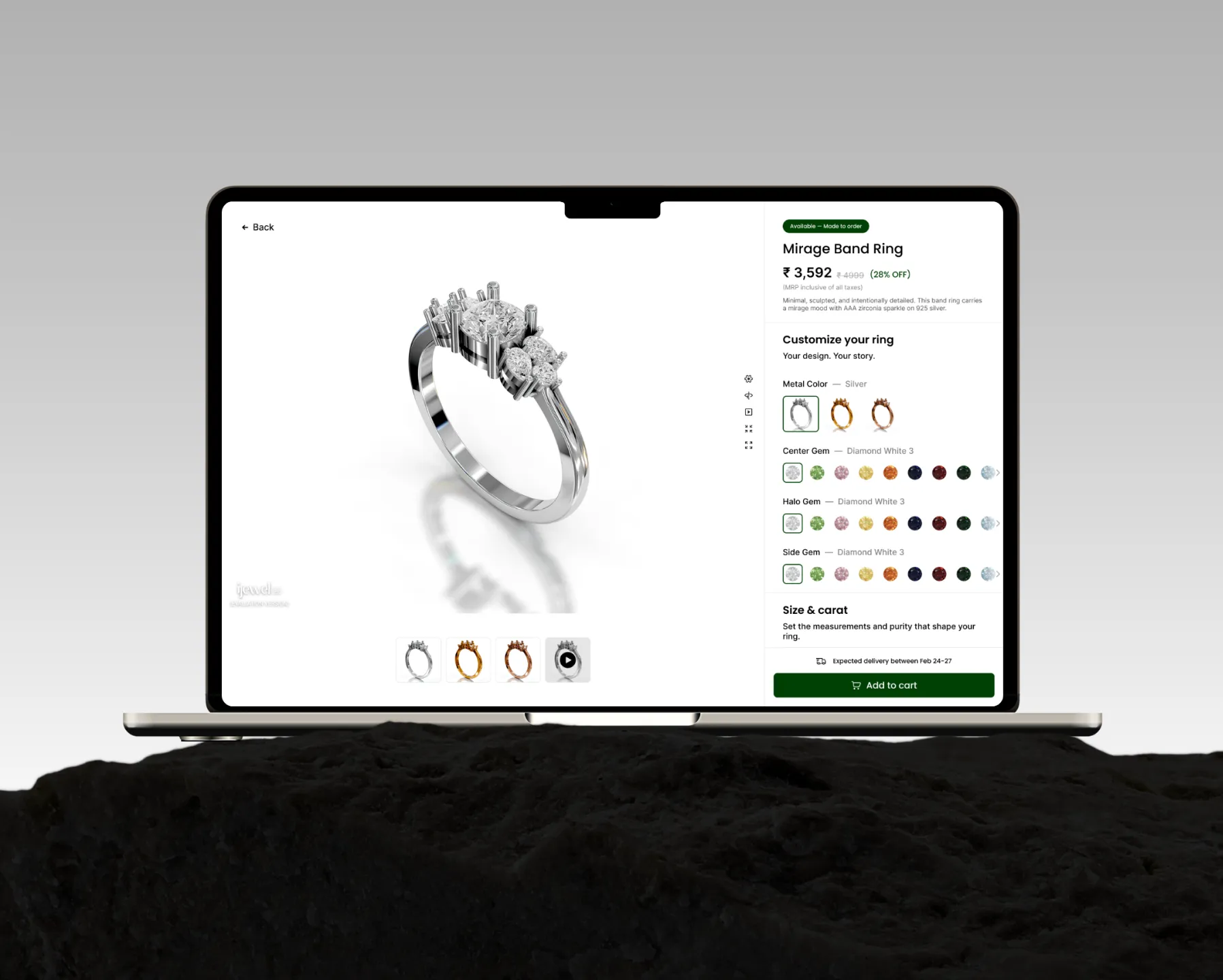
Instead of static photo carousels, customers interact with live 3D models of each piece. They can swap metals — say, Sterling Silver to 18k Rose Gold — or change gemstone types, and the viewer re-renders the piece in real time.
This fundamentally shifted the user journey from passive browsing to active customization. Customers don't just view jewelry; they build it.
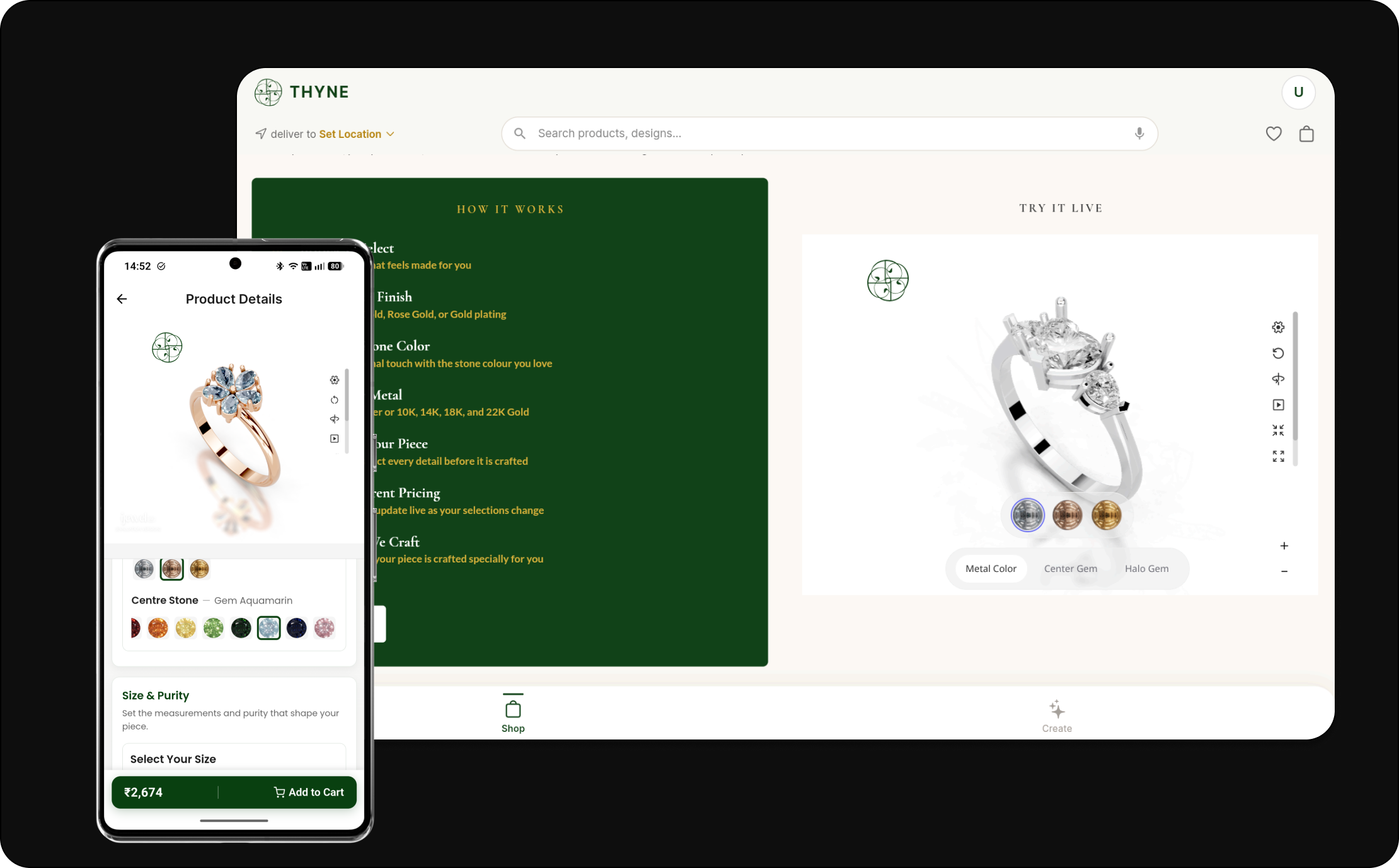 Real-time 3D customization on Android — gem type, metal, and stone colour update the render instantly.
2. Omnichannel Storefront
A single Flutter codebase powers iOS, Android, and web — with instant transitions between product grids and detail pages across all three. No compromises on any platform.
Advanced filtering and search make it easy to navigate a deep catalog, and the custom frontend approach means every interaction feels immediate, never sluggish.
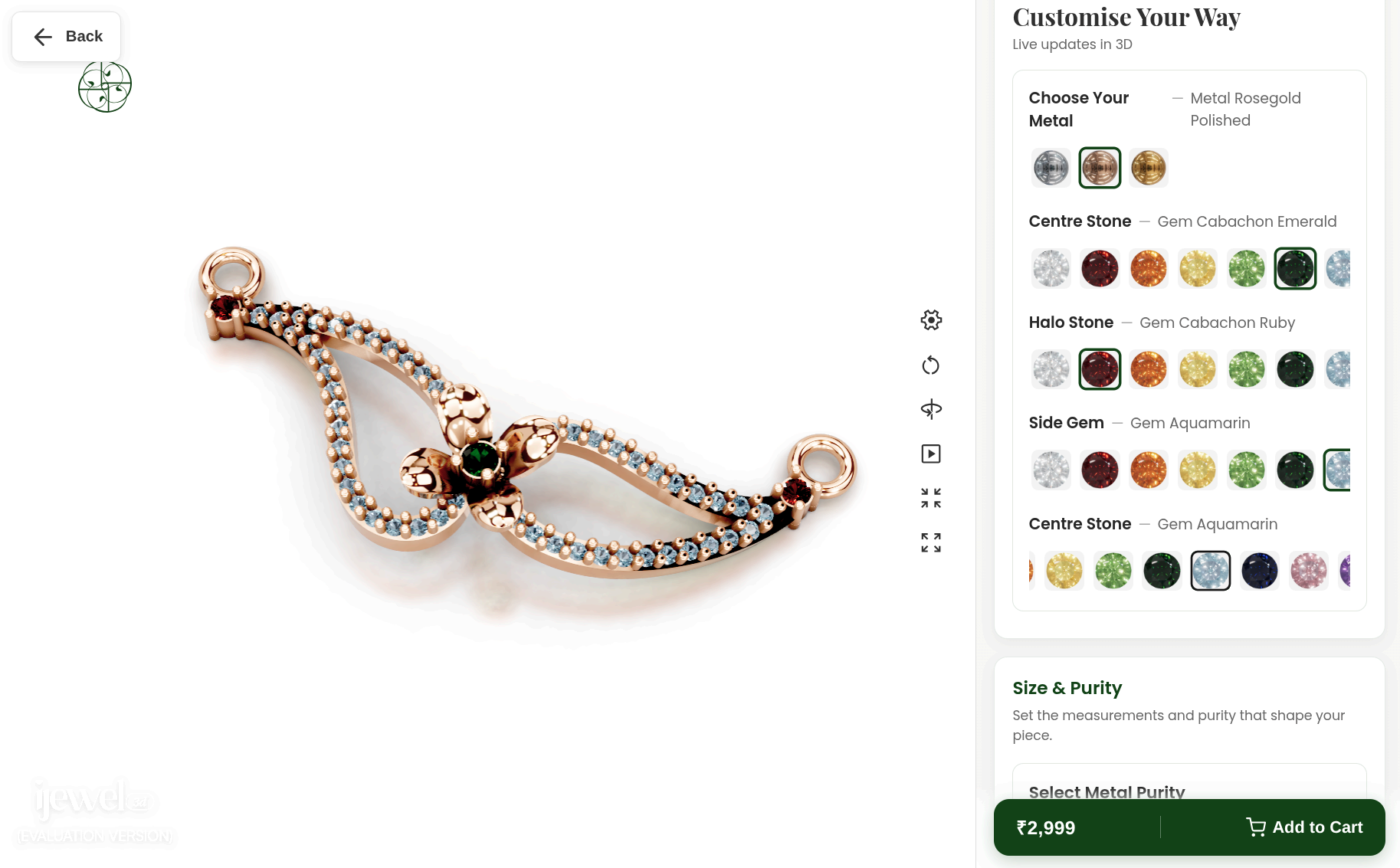 The web experience — metal colour, centre gem, and halo gem selections update the 3D render live.
3. Frictionless Checkout
A beautiful experience means nothing if the checkout fails. We engineered a resilient cart and order management system with Razorpay for secure, multi-method payment processing.
We also added Guest Checkout — removing the friction of forced account creation and capturing impulse buyers at the moment of intent.
4. Unified Admin Dashboard
While the storefront dazzles customers, the dashboard empowers the business. A comprehensive, role-based Command Center puts inventory management, bulk ingestion, and order oversight into a single secure interface — replacing a patchwork of third-party tools with one source of truth.
Hard Engineering Problems We Solved
Bridging the 3D gap. Delivering an immersive 3D viewer required synchronizing product configurations, inventory data, and customer selections across Flutter and Three.js simultaneously — without any visible lag or state mismatch.
Handling complex product matrices. A single ring might have 40+ combinations of metal, ring size, and gemstone. We designed a flexible product architecture that handles thousands of variants without duplicating data or creating inventory management overhead.
Automating inventory ingestion. Migrating thousands of highly nested products from legacy spreadsheets manually is slow and error-prone. We built a high-performance ingestion pipeline that parses messy source files and creates product entries automatically — reducing what took days to minutes.
AI-powered custom design requests. Not every customer finds exactly what they're looking for in the catalog. We built a custom design flow powered by Google Gemini 2.5 Flash: customers describe the piece they have in mind, the AI generates a photorealistic image of it, and if they're happy with the result, the request is sent directly to the Thyne Jewels team to bring it to life. It turns a dead end — "I don't see what I want" — into a bespoke commission pipeline.
The Results
| Metric | Before | After |
|---|
| Product onboarding time | Days | Minutes |
| Platforms served | Separate builds | iOS, Android & Web — one codebase |
| Inventory & order management | Multiple third-party tools | Single unified dashboard |
| Custom design requests | No pathway for bespoke orders | AI-generated preview → direct team handoff |
Beyond the numbers, the launch delivered something harder to measure: a digital experience that actually feels like the brand. Customers engage with the product before they buy it. The operations team has full visibility. And the architecture scales without drama when traffic spikes.
Technology Stack
| Layer | Technologies |
|---|
| Frontend | Flutter (iOS, Android, Web) |
| 3D Visualization | React, Vite, Three.js |
| Backend & API | Go (Golang) |
| Database | MongoDB |
| Payments | Razorpay |
| AI Integration | Google Gemini 2.5 Flash |
| Infrastructure | AWS (EC2, S3, CloudFront), GitHub Actions, Codemagic |

 Valnee