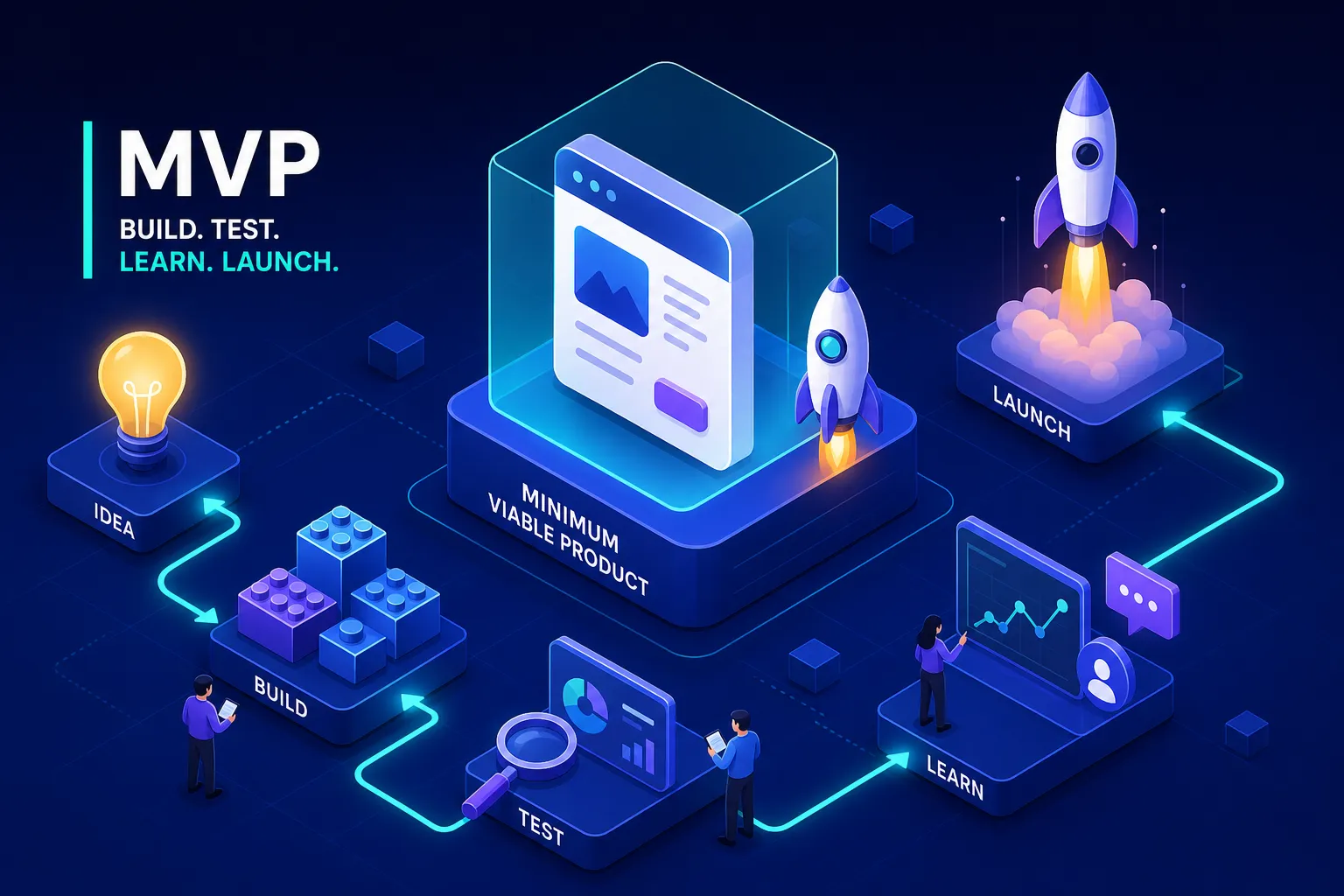
Many first-time founders fall into one of two traps. They spend eight months building every feature they can imagine, burn through their runway, and launch something nobody asked for. Or they strip the product down so far that it cannot do anything useful, get no real feedback, and call it "lean." Neither approach reflects what a minimum viable product is actually meant to be.
Eric Ries defined it precisely in The Lean Startup: "that version of a new product which allows a team to collect the maximum amount of validated learning about customers with the least effort." Notice what that definition is and is not saying. It is not saying ship something broken. It is not saying build everything. It is saying: find the fastest path to a real answer about whether your product idea works. At Valnee Solutions, we frequently see these misunderstandings in early-stage founders we work with. Founders either arrive with a feature list that belongs on a Series B product, or they want to launch something so minimal it cannot even demonstrate the core value.
By the end of this guide, you will know exactly what a minimum viable product is, how to scope one correctly, which mistakes to avoid, and how to tell if the product you have shipped is actually working.
What a minimum viable product actually means
The word "minimum" is where most founders go wrong. They read it as "incomplete" or "cheap." What it actually means is ruthlessly focused. A product that solves one problem exceptionally well for one specific user is far more valuable than a product that half-solves ten problems for nobody in particular. The goal is not to impress users with breadth. The goal is to test one assumption with as little investment as possible.
"Validated learning" is the other phrase worth unpacking. You are not building a product and hoping users like it. You are running an experiment. You form a hypothesis, say, "small business owners will pay for automated invoicing if it takes less than two minutes to set up", and you build the smallest thing that can confirm or disprove it. The data you get back is evidence, not opinion. That distinction matters, because opinions from friends and family are nearly useless. Behaviour from real users trying to solve a real problem is not.
Three principles, drawn from Lean Startup methodology, anchor every well-built minimum viable product. First, it solves one real problem for one specific type of user. Second, it is built to test a hypothesis, not to impress anyone. Third, it generates feedback you can actually act on. Keep these in view during your scoping process. When a feature does not serve all three, it does not belong in the MVP. The feature founders most often try to smuggle through is a "nice-to-have" dashboard or reporting screen, useful in principle, untestable in practice.
MVP vs prototype vs minimum marketable product: clearing up the confusion
These three terms are often used interchangeably, and that causes real problems. A prototype is a simulation, it demonstrates how a product might look or feel, but real users cannot use it to accomplish a real task. An MVP is functional: real users accomplish real tasks with it, and you observe real behaviour. The distinction matters because a prototype answers "will users understand how this works?" while an MVP answers "will users pay for this?" If you are still at the design and flow stage, you need a prototype. If you are ready to test market assumptions, you need an MVP.
A minimum marketable product (MMP) is different again. It is the smallest version of a product you can sell commercially, and it comes after the MVP. The MVP is a learning tool; the MMP is a revenue vehicle. Founders who confuse the two either launch too early, before they know enough about their users, or delay shipping indefinitely because they keep trying to reach "market-ready" before validating anything. The correct sequence is: prototype to test design assumptions, MVP to validate the core idea, MMP to start selling properly.
A simple way to remember the difference: a prototype asks whether you can build it, an MVP asks whether users want it, and an MMP asks whether you can sell it. Most founders skip straight from prototype thinking to MMP thinking and wonder why their launch falls flat.
What real-world MVPs teach first-time founders
The most cited minimum viable product examples are usually taught as inspiration. They are more useful as instruction. Dropbox did not build file-syncing software first. Drew Houston recorded a three-minute screencast showing how it would work, posted it to a community of early adopters, and watched the waitlist grow from 5,000 to 75,000 overnight. The video was the MVP. It tested whether demand existed before a single line of production code was written.
Zappos took a similarly manual approach. Nick Swinmurn built a basic website, photographed shoes from local stores, and when someone placed an order, he bought the shoes in person and shipped them himself. No inventory system, no warehouse, no logistics software. Just a test to answer one question: will people buy shoes online? Airbnb started with air mattresses in the founders' apartment and a simple website. They confirmed that strangers would pay to stay in someone else's home before building any of the marketplace infrastructure that Airbnb runs on today.
These examples span different eras and markets, yet they share the same logic. Each founder identified one assumption that, if wrong, would kill the business entirely, then tested it with the least effort possible. Before writing any code, ask yourself: what is the one thing that has to be true for this product to work? Then find the cheapest, fastest way to test that one thing. Everything else can wait.
How to scope a minimum viable product without overbuilding
Scoping is where most founders lose time and money. They arrive with a feature list built around excitement, not evidence. The right starting point is not features at all, it is the user's most painful problem. Write one user story: "As a [specific user type], I want to [do one thing], so that [I get one specific outcome]." Every feature that does not directly serve that story is out of scope for the MVP. No exceptions, no negotiations.
Apply the MoSCoW framework
Once you have the user story, apply the MoSCoW framework to your feature list. MoSCoW stands for Must-have, Should-have, Could-have, and Won't-have. Most features that feel like "must-haves" are actually "should-haves" or "could-haves" once you examine them honestly against the user story. A well-scoped MVP typically contains a small set of core features, often just a handful, and nothing more. At Valnee Solutions, the MoSCoW exercise is the first thing we do with every founder during our vision alignment and scoping phase, before any development begins. It is the single biggest reason our builds stay on track and launch on schedule.
Lock scope in writing
Founders who scope alone tend to expand scope as they get more excited about the product. A structured partner pushes back. Valnee's end-to-end MVP roadmap runs from the initial scoping session through the feature backlog and milestone tracking, with a fixed price and a committed launch date documented from the start. Founders do not just agree on scope during a kick-off call; they agree on it in writing. That structure is what prevents feature bloat from derailing a build mid-sprint.
Write clear acceptance criteria
For each must-have feature, write a simple acceptance criterion: what does "done" look like for this feature from the user's perspective? If you cannot describe the end state in one sentence, the feature is not scoped clearly enough to build. This discipline catches ambiguity before it becomes expensive rework.
The most common mistakes founders make when building an MVP
Feature bloat is the most predictable mistake. Founders add features to make the product feel complete before users have validated a single one. The result is a launch that arrives months late, over budget, and still does not confirm whether the core idea works. The fix is straightforward: ship the minimum that tests your riskiest assumption, then add features only when users ask for them repeatedly and clearly, not because you think they might want them, but because they have asked, more than once, in their own words.
Some founders overcorrect in the other direction. They ship so little that users cannot accomplish the core task, or the quality is poor enough to skew the feedback. An MVP must be functional, stable, and genuinely useful for its core use case. It does not need to be beautiful or feature-rich, but it must work reliably. Users will forgive a narrow product. They will not forgive a broken one, and they will not give you honest feedback about a product that did not function well enough to be worth using.
The third mistake is launching without a feedback loop. An MVP with no analytics, no user interviews, and no feedback mechanism is not an MVP, it is just an early-stage launch. Set up your metrics dashboard before you launch, not after. If you are not tracking where users activate, where they drop off, and what they say when they leave, you have nothing to act on. The entire point of an MVP is to generate evidence. If you are not collecting it, you have wasted the build.
Minimum viable product validation metrics: how to know if it is actually working
Once the product is live, two metrics matter more than anything else: activation and retention. Activation measures whether users reach the product's first genuine moment of value. Retention measures whether they come back. These two signals are the most honest early indicators of whether the MVP is delivering on its promise.
For directional benchmarks, Lenny Rachitsky's widely referenced SaaS research suggests activation rates above 30 to 40 per cent are a reasonable early target, while Day 7 retention thresholds vary considerably by product type and source, some product analysts treat anything above 20 per cent as strong for early-stage tools, while others set the bar closer to the high single digits. Treat any benchmark as a reference point, not a pass-fail threshold. What matters more is your trend: is activation improving week on week, and are the users who activate coming back?
Knowing when to iterate versus when to pivot is the harder skill. Iteration means refining the existing product based on what users tell you is broken or missing. A pivot means the core assumption was wrong and the direction needs to change. Most founders iterate too slowly because they are attached to their original idea. The signal for a pivot is not one bad week of metrics. It is a consistent pattern showing that users are not finding value in the core use case, no matter how much you refine it. Qualitative feedback from user interviews usually surfaces this well before the numbers confirm it, which is why talking to users regularly is not optional.
Build to learn, not to launch
A minimum viable product is not a shortcut or an excuse to ship something unfinished. It is a structured method for learning the most important thing about your product with the least possible investment. Define the problem clearly, scope to the absolute minimum that tests your riskiest assumption, ship something that actually works, and measure real behaviour before adding anything new.
The founders who build the best MVPs are not the ones with the longest feature lists. They are the ones with the clearest questions. They know what they are testing, why it matters, and what a pass or fail result looks like before they write a single line of code. That clarity is what separates a lean startup MVP that validates fast from one that burns runway and never quite launches.
If you are ready to scope your first MVP with a team that has done this before, Valnee Solutions works with founders at every stage, from the first scoping session to launch day. Start with a conversation about what you are building, and we will help you define what it actually needs to be. When the scope is right, the build follows.

 Valnee