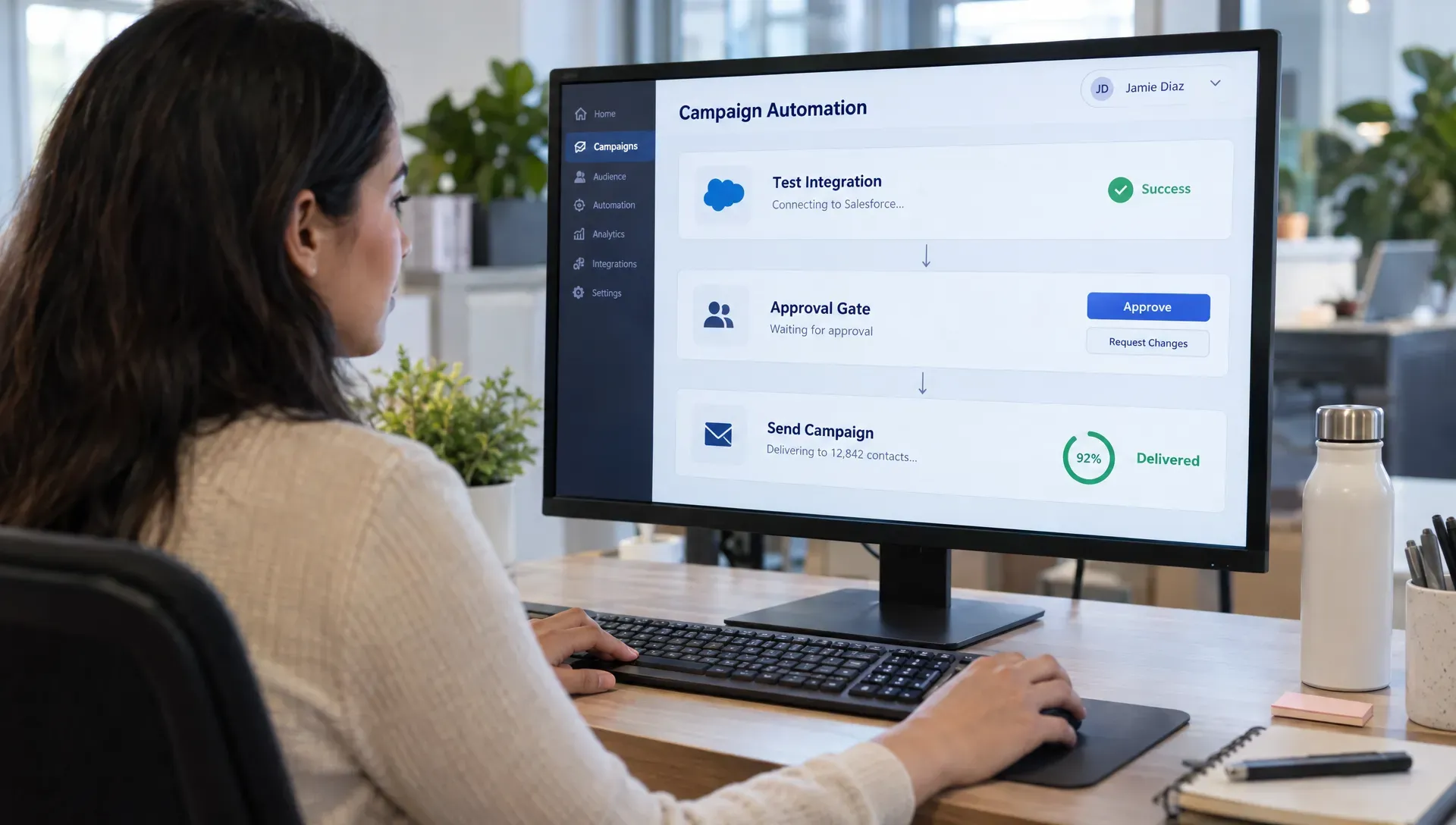
A focused custom ai driven marketing automation MVP can be budgeted at $40,000 to $80,000 using the planning assumptions below. A broader production SaaS platform could require $90,000 to $180,000 or more. These are illustrative estimates, not Valnee prices or fixed quotes. Your actual budget depends on workflow complexity, integrations, data readiness and the reliability customers expect.
If you are building a platform rather than subscribing to an existing tool, separate three decisions: what the first release must accomplish, what infrastructure makes it dependable and what it will cost to operate after launch.
The table below uses an assumed blended delivery rate of $50 to $100 per hour. This is a calculation assumption, not a claim about market rates. The hours represent example scopes, including product work, engineering and testing.
| Build scenario | Illustrative effort | Calculated build budget | Scope assumption |
|---|
| Internal workflow pilot | 250 hours | $12,500 to $25,000 | One workflow, one integration and human review |
| Focused customer-facing MVP | 800 hours | $40,000 to $80,000 | Narrow use case, basic account access, one or two integrations and limited reporting |
| Production SaaS platform | 1,800 hours | $90,000 to $180,000 | Tenant isolation, role-based access, billing, several integrations and operational controls |
| Broader automation suite | 3,000 hours | $150,000 to $300,000 | Multiple workflow types, deeper integrations and expanded administration |
These are separate scope examples, not consecutive invoices. If you develop incrementally, ask which components can carry forward rather than assuming every stage requires a complete rebuild.
For ai driven marketing automation, the useful budgeting question is not how many screens you need. It is how many business processes the platform must execute reliably, across how many systems and customers.
The requirements that change your development cost
A bounded workflow versus a general-purpose builder
A workflow that drafts campaign content from an approved brief is relatively bounded. A platform that lets customers create their own triggers, branching rules and autonomous actions requires substantially more engineering.
The latter needs workflow state management, retries, execution history, permission checks and controls for failed or partially completed actions. A polished drag-and-drop interface does not remove those backend requirements.
Keep the initial release specific. For example, ingest an approved brief, generate a draft, route it for review and transfer the approved result to one destination. This is easier to estimate than “automate our marketing.”
Integration depth and data quality
Connecting to a CRM can mean importing contacts once. It can also mean maintaining two-way synchronization, resolving duplicate records, mapping custom fields and handling expired credentials.
Those are different projects. Before commissioning ai driven marketing automation, document the exact objects, permissions and synchronization behavior each connection requires.
Existing data also affects scope. Inconsistent campaign names, missing consent records or fragmented customer identifiers may require cleanup and mapping before automation becomes useful. Identify that work during discovery rather than treating it as an unexpected development problem.
AI quality and execution safeguards
Generating plausible text is not the same as producing dependable marketing output. Your platform may need brand guidelines, structured responses, retrieval from approved material and tests against representative examples.
If AI can publish content, update records or initiate outreach, add authorization checks and approval gates. The higher the consequence of an incorrect action, the more validation and recovery work belongs in the budget.
Define acceptance criteria before implementation. Examples include preserving required fields, avoiding unsupported product claims and preventing duplicate actions after a retry. These requirements are more useful than a promise that the platform will be “highly accurate.”
Scope the MVP around one valuable customer outcome
A commercially useful MVP should complete a meaningful job, not demonstrate every feature you might eventually sell.
For a campaign-assistance platform, the initial scope might include:
- One primary user: A marketer preparing campaigns for a defined business segment.
- One complete workflow: Brief intake, draft generation, review and approved export.
- Limited connections: One source system and one destination system.
- Essential controls: Account access, customer data separation, execution logs and usage limits.
- A measurable result: Reduced preparation time or fewer manual handoffs, measured against the existing process.
An illustrative 800-hour allocation could look like this:
| Workstream | Planning hours |
|---|
| Discovery and acceptance criteria | 80 |
| UX, interface and core application | 160 |
| Workflow orchestration and integrations | 200 |
| AI implementation and evaluation | 120 |
| QA, security checks and failure handling | 160 |
| Deployment, documentation and launch support | 80 |
| Total | 800 |
This allocation is a scoping exercise, not a delivery commitment. An unusually complex integration could consume much of the workflow allowance by itself.
A sensible ai driven marketing automation MVP postpones breadth, not essential safeguards. You can defer additional channels or advanced analytics, but customer data isolation and reliable execution should not be optional additions to a customer-facing release.
Product references: SignalMint and ReachSaga
SignalMint demonstrates a staged development approach
Valnee's SignalMint case study describes a marketing intelligence MVP built from scratch in 21 days and subsequently expanded with AI capabilities.
The useful budgeting lesson is the sequence: establish the initial product, then extend it. The reported timeline does not establish a price for your project or imply that a fully featured automation SaaS can be delivered in the same period.
When discussing a comparable build, ask which capabilities were included in the initial release, what was added later and how your integrations differ. Compare scope and acceptance criteria rather than borrowing a headline delivery time.
Use ReachSaga to clarify the product experience you want
Review ReachSaga as a product reference when preparing your brief. Identify the particular experience or outcome you want to emulate, rather than requesting an unspecified “similar platform.”
For implementation context in the search and AI visibility category, Valnee's SagaAI case study describes a platform combining technical SEO and AI answer-engine visibility. This is a distinct reference from a campaign execution tool, even if both serve marketing teams.
A reference product helps define requirements for ai driven marketing automation, but it cannot reveal all the underlying costs. Data collection, scheduled jobs, reporting infrastructure and operational support need their own scope assessment. Visible screens alone are not enough to estimate a comparable build.
Separate the build budget from monthly operating costs
Your development invoice is only one part of total ownership cost. After launch, you may pay for model usage, hosting, databases, monitoring, external data providers and engineering maintenance.
For a subscription product, calculate these costs at an expected customer count and usage level. A platform can look inexpensive during testing and become difficult to price once customers run frequent workflows.
A worked example of AI usage costs
Assume a small platform has 200 active customers, each running 40 workflows per month. If each workflow makes three model calls, that produces 24,000 calls per month.
At an average of 4,000 input tokens and 1,000 output tokens per call, monthly usage becomes 96 million input tokens and 24 million output tokens.
For illustration only, assume a model price of $1 per million input tokens and $5 per million output tokens:
Monthly model cost = (96 × $1) + (24 × $5) = $216.
These are hypothetical prices, not a current provider quote. Check the chosen provider's published rates, such as OpenAI's API pricing, before approving your operating budget.
The model bill for ai driven marketing automation depends on actual execution behavior. Long context, repeated calls, failed attempts, web tools and more expensive models can change this calculation substantially. Measure complete workflow cost, not just the cost of one successful generation.
An illustrative monthly operating allowance
Using the same hypothetical usage profile, a planning worksheet might include:
| Operating item | Illustrative monthly allowance |
|---|
| Model usage from the calculation above | $216 |
| Hosting, database and storage | $150 to $500 |
| Monitoring and operational tooling | $50 to $200 |
| External data or messaging services | $150 to $600 |
| Routine engineering maintenance | $500 to $2,500 |
| Calculated total | $1,066 to $4,016 |
These allowances are assumptions, not supplier quotes. Maintenance assumes 10 to 25 hours at the example hourly rates and excludes new features, round-the-clock staffing and major incidents. The worksheet also excludes sales, customer support and legal expenses.
Put usage caps, cost attribution and alerting into the launch scope. They help you understand which customers or workflows consume the most resources before you commit to subscription pricing.
How to request a comparable quote for ai driven marketing automation
A useful proposal connects price to deliverables. An inexpensive quote that excludes integrations, QA or production support may become more expensive than a fuller proposal once those requirements surface.
Give each potential development partner the same brief. Include the primary customer, workflow steps, source and destination systems, expected usage, approval rules and a clear definition of completion.
Ask the proposal to distinguish discovery, implementation, third-party charges and post-launch support. It should also explain assumptions, exclusions, code ownership, deployment access and how scope changes are approved.
Structure the work around acceptance milestones
A practical delivery sequence is discovery, a validated workflow, a working pilot, hardening and release. Each milestone should have something you can inspect or test.
For example, an integration milestone might require an approved action to reach the destination exactly once, with a visible error state if delivery fails. An AI milestone might require the output to pass an agreed evaluation set and route uncertain cases to review.
Reserve contingency separately from known costs. If the implementation estimate is $60,000 and you choose a 20% planning reserve, the authorized build budget becomes $72,000. That reserve is not a substitute for pricing already-known requirements, and it should not be treated as automatically spent.
Custom development makes the strongest case when the workflow is central to your business, existing tools cannot support it adequately or you intend to sell the platform to customers.
If standard software already completes the process well, configuring it may be the better commercial decision. You can also validate demand with existing tools before investing in a proprietary product.
For an internal platform, evaluate ai driven marketing automation against measurable process improvements. Include review time, exception handling and maintenance when calculating the benefit. Hours saved are not automatically cash savings unless they reduce expenditure or create demonstrable additional value.
For a SaaS product, use a contribution-margin model instead: expected revenue minus usage costs, support and other variable expenses. Test whether customer demand justifies the build before expanding the feature set.
The right decision is not “custom is better.” It is whether ownership of this particular workflow justifies the initial investment and ongoing responsibility.
Frequently asked questions
What is a reasonable starting budget for a custom marketing automation MVP? Under the assumptions in this article, an 800-hour focused MVP produces a $40,000 to $80,000 planning range. A smaller internal pilot can cost less, while complex integrations or customer-facing SaaS requirements can increase the scope substantially.
Can we launch quickly and add AI capabilities later? Yes, where the product supports that sequence. SignalMint provides an example of an initial marketing intelligence MVP followed by AI expansion. Your schedule still depends on the initial requirements, integration access and acceptance criteria.
Is the AI model usually the largest expense? Not necessarily. In the worked example, model usage is smaller than engineering maintenance. Actual costs depend on model selection, context size, tools, retries and customer activity. Measure your own workloads before setting prices.
What should we prepare before requesting an estimate? Bring a workflow description, integration list, representative data, expected usage and examples of acceptable outputs. Include product references with specific capabilities identified, rather than asking for a complete clone.
Turn your workflow into a scoped build plan
Valnee Solutions supports product strategy, MVP development, custom applications, QA and maintenance. Its AI and agentic systems services cover AI agents and intelligent workflows.
To discuss an ai driven marketing automation platform, start with one customer outcome, the systems it must connect and your launch budget. Include SignalMint or ReachSaga as references, with the exact elements relevant to your product. That gives the project discussion a concrete scope instead of an open-ended feature wishlist.

 Valnee