You've found three off-the-shelf tools that each solve most of your problem. None of them solve all of it. You're duct-taping them together with Zapier, manually exporting spreadsheets to fill the gaps, and wondering whether you should just "build something custom." But you have no idea what that actually costs, how long it takes, or who to trust with the work. If you're weighing up custom software for your startup, this guide gives you the full picture before you commit a single rupee.
At Valnee Solutions, this is a common conversation with first-time founders. The choice between building bespoke software and buying an existing product isn't purely a technology decision. It's a business strategy call that affects your runway, your time to market, and whether you actually own the product when it's done. Get it right and you have a real competitive advantage. Get it wrong and you've spent six months and a significant portion of your savings on something that doesn't ship.
This guide covers what custom application development actually means, when to build versus buy, what the process looks like, what it costs in India, and how to vet a development partner so you don't end up with half a product and an empty bank account.
What custom software actually means (and what it doesn't)
Founders often assume that if they've paid for software, it must be custom. It isn't. There's a hard line between bespoke development and simply configuring an existing platform, and knowing the difference will save you a great deal of confusion when you start approaching vendors.
Bespoke vs packaged: the core difference
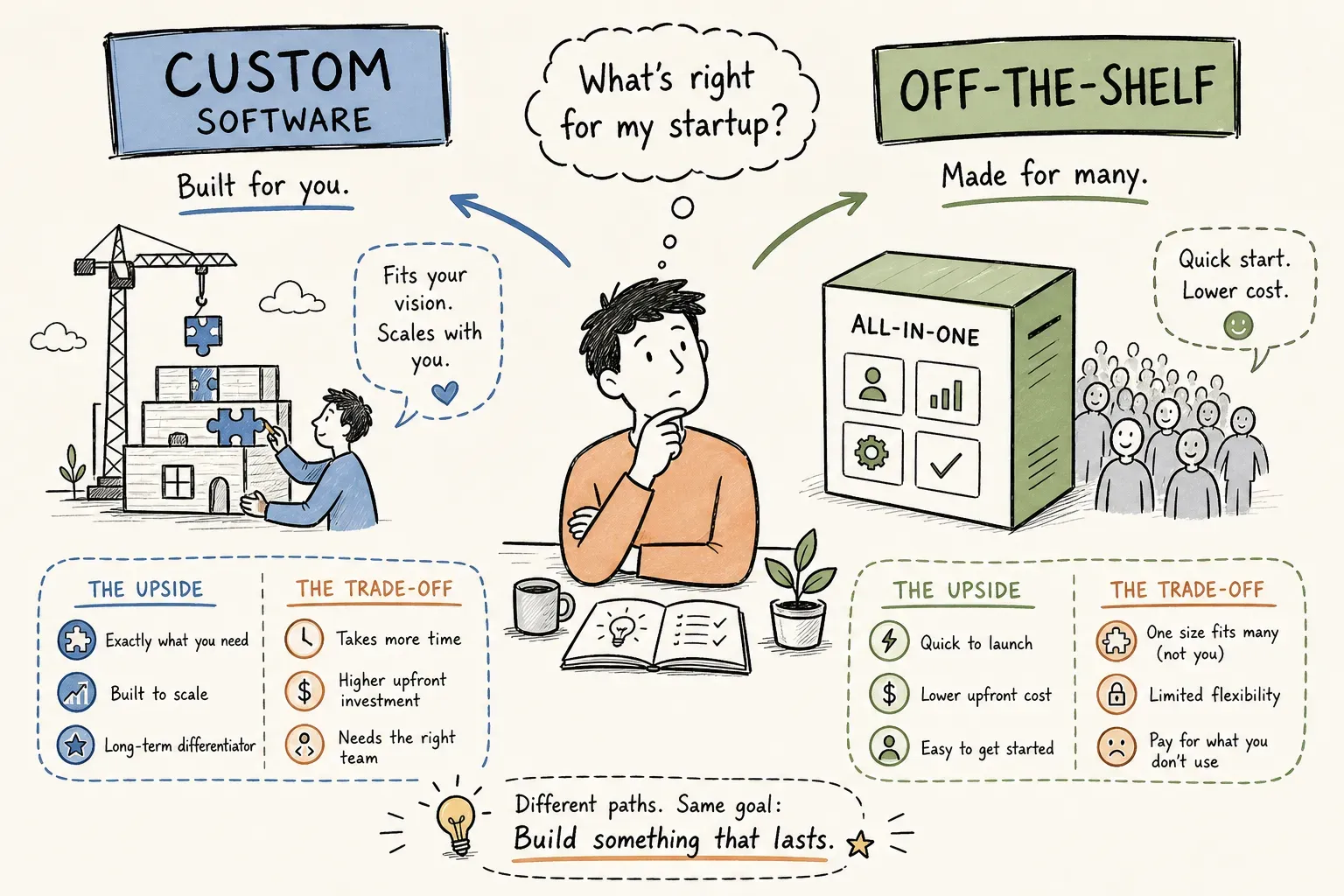
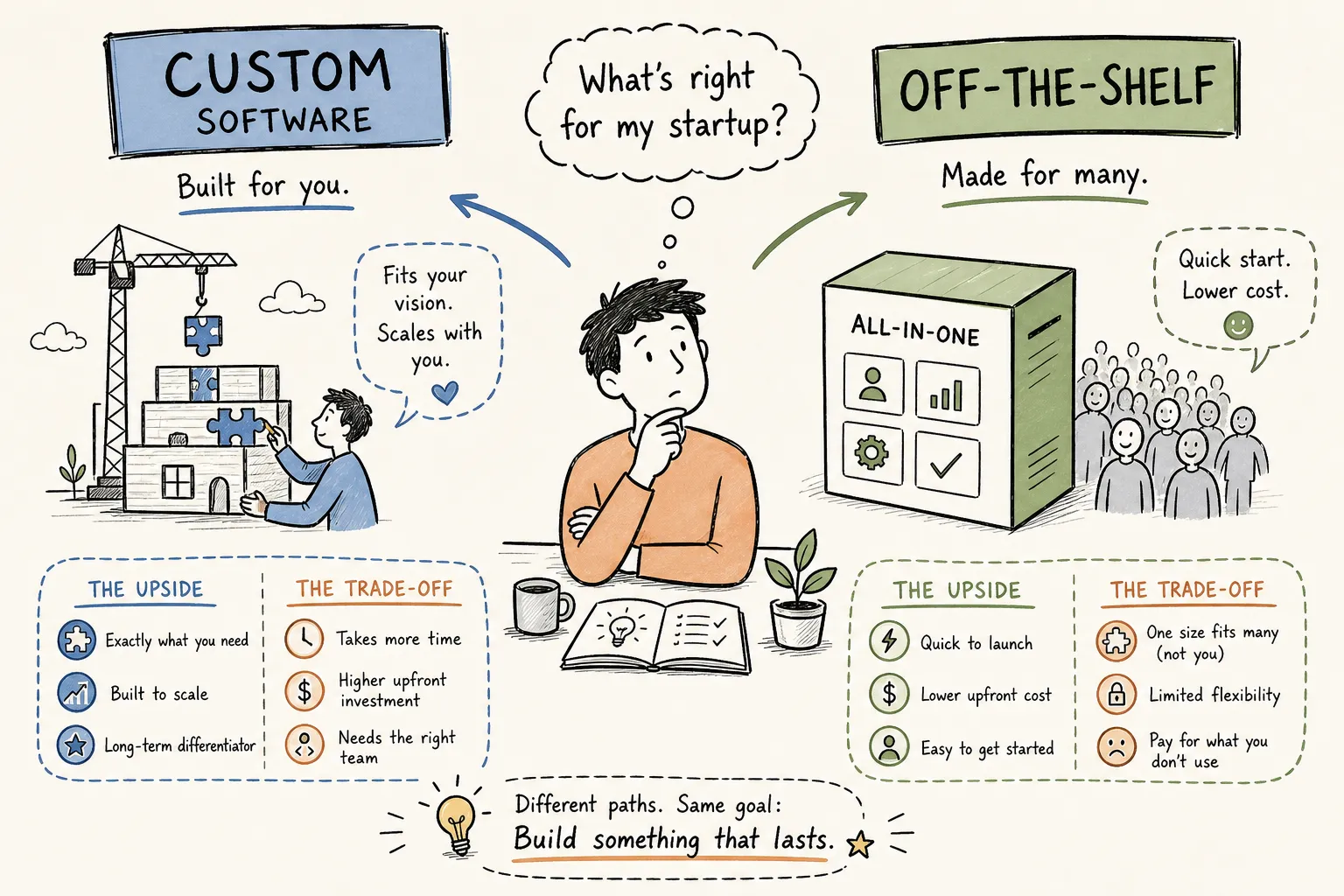
Custom software is built from scratch, or from a clean codebase, to match your specific workflows, user types, and business logic. Off-the-shelf software is pre-built for the widest possible audience. The clearest way to put it is this: custom software adapts to the business, while off-the-shelf software makes the business adapt to the software. That single distinction should anchor every decision you make in this process.
Configuring Salesforce is not custom software development
Turning on features, adding fields, or connecting a Zapier workflow in an existing SaaS tool is configuration. It's not bespoke application development, and it's not generally treated as such by vendors. The distinction matters because founders sometimes over-invest in configuration, spending months and real money customising an off-the-shelf product, when they'd be far better served building something that actually fits. If you're configuring an existing platform, you're still bound by its data model, its pricing, and its roadmap decisions. You own none of it.
The honest answer is that custom software development isn't the right move for every founder at every stage. The decision depends on where you are in the validation cycle, what your runway looks like, and whether the gap between what existing tools do and what you actually need is genuinely unbridgeable.
The first signal is that no existing SaaS tool can handle your specific data model, and the workarounds you've created to compensate are now generating errors or eating into your team's time. The second is that you're connecting multiple tools just to complete one core workflow, which means you have no single source of truth and every integration is a potential failure point.
A third, competitive trigger is worth taking seriously: if a direct competitor is using the same off-the-shelf tool you are, that tool gives you no differentiation. Any feature advantage it offers is available to them equally. These are the triggers that most reliably bring founders to a custom development conversation.
When off-the-shelf is genuinely the smarter call
If you're still pre-validation, if an existing tool does 90% of what you need, or if your runway is under six months, commissioning a bespoke build may not be the right move yet. Validation should come before commitment. Valnee Solutions offers a free waitlist builder that lets founders test market demand with real users before spending a single rupee on development, a low-risk entry point that answers the most important question first: do people actually want what you're planning to build?
Custom software cost and timeline: what to expect in India
Vague answers from vendors are a red flag, not a feature. Here are concrete numbers for the India market in 2026, so you can pressure-test any proposal you receive against a realistic baseline.
Realistic budget ranges for first-time builds in India
Most startup builds fall into one of three tiers. A basic MVP with core features and a single user role typically runs between ₹2 and ₹8 lakh. A medium-complexity build with multiple user roles, integrations, and dashboards sits in the ₹8 to ₹30 lakh range. Complex, enterprise-grade customised software solutions with compliance requirements, heavy integrations, or multi-module architecture start at ₹30 lakh and move up from there. What drives cost up is predictable: the number of third-party integrations, compliance requirements, custom workflow logic, and the number of distinct user roles the system needs to support. Fixed-price contracts protect founders from budget overruns. That said, fixed-price works best when the scope is well defined; have a lawyer review the contract terms and understand the trade-offs before signing, since time-and-materials arrangements can suit exploratory or rapidly evolving projects.
Timeline expectations from first meeting to launch
A typical SME-scale custom build takes three to six months from first meeting to deployment. Discovery and scoping take one to three weeks, development takes the bulk at four to ten weeks, and QA plus deployment typically add a further two to six weeks depending on scope and complexity. The most common timeline mistake founders make is underestimating how long scoping takes. A partner who cannot give you a preliminary timeline range in the first conversation, even a broad one, with the variables explained, is passing their uncertainty directly onto you. That's not a negotiating style; it's a process problem.
What the build process looks like stage by stage
Most non-technical founders have no clear picture of what a development engagement actually looks like from the inside. Here's the linear walkthrough, with the caveat that good development is iterative: feedback from testing often sends you back to earlier phases, and that's expected.
Discovery and scoping: where projects succeed or fail
The discovery phase, typically one to two weeks, is where your idea becomes a plan. A credible partner produces a clear scope document, a feature priority list, and a project roadmap. Founders who skip this phase or rush through it almost always face scope creep, missed deadlines, and the demoralising experience of watching their budget drain into a product that still isn't live. Scoping is where you decide what not to build. That constraint, deciding which features stay out of the first version, is precisely what keeps an MVP lean enough to actually launch.
From design to deployment: what happens in between
The design phase covers wireframes, system architecture, and the data model. The build phase runs in iterative sprints, with code reviews, integration builds, and regular progress check-ins. After development, QA covers test cases, defect resolution, and user acceptance testing to confirm the product behaves the way the scope document specified. Deployment is followed by what's often called a hypercare window: the first two to six weeks after go-live when real users interact with the product for the first time and edge cases surface that no test environment could fully predict. Post-launch support is not optional. Any partner who treats go-live as the end of the engagement is leaving you alone at the most critical moment.
How to vet a development partner without getting burned
This is the most important section in this guide for first-time founders. Choosing the wrong technical partner is far more costly than choosing the wrong tool. Here's how to screen vendors before you sign anything.
Questions to ask before you sign anything
These are not optional conversation starters. They are non-negotiable due diligence questions, and any credible partner should answer them clearly and without hesitation:
- What stack will you use, and why is it the right fit for this product?
- Who exactly will work on this project, and what are their roles?
- How do you handle scope changes without blowing the budget?
- What happens if you miss the launch deadline?
- Do I own 100% of the code from day one?
If a vendor fumbles on any of these, especially the last two, walk away. A vague answer to "what happens if you miss the deadline" often means the client bears much of the schedule risk, so treat any hesitation here as a serious warning sign.
What real accountability looks like in a contract
A founder-protective development contract should include three things written explicitly into the agreement: a fixed price with no surprise invoices, a clearly defined launch deadline backed by real contractual consequences if it slips, and full code ownership transferred to the client from day one. The specific form those consequences take will vary by project and jurisdiction, so have a lawyer review the terms before signing. At Valnee Solutions, missed-deadline consequences are set out explicitly in the contract, billing is paused and work continues at no cost until the agreed milestone is delivered. Any partner who refuses to discuss accountability terms in writing is passing the risk entirely onto you.
Red flags that signal a bad partner before work starts
Watch for vague project plans with no milestone dates: if a vendor can't tell you what gets delivered in week four, they don't have a plan. Hourly billing with no ceiling is equally dangerous for an MVP, because your budget exposure is unlimited. Have a lawyer review any NDA that contains IP clauses favouring the agency before you sign. Finally, no verifiable portfolio of completed, working products, not mockups, not "in progress" examples, means the risk of a non-delivery is real and unquantified.
A founder's checklist before commissioning a custom software build
The quality of the proposals you receive from vendors is directly proportional to how clearly you can articulate what you need. Founders who approach a development partner with a clear brief get far better work, at far better prices, than founders who arrive with "I have an idea for an app."
Internal readiness: what to have before you approach a partner
Before you make a single call, you need four things: a clear problem statement (not a product idea, but a specific problem you've seen real users struggle with), a feature list split into must-have and nice-to-have, a realistic budget range you're prepared to commit to, and evidence that real users want what you're building. Founders who arrive with validated demand, a waitlist, pilot users, or early sign-ups, are in a fundamentally stronger position than founders who arrive with a vision deck alone.
How to shortlist vendors without wasting weeks on calls
Eliminate any vendor who can't provide references from similar projects, has no completed portfolio of shipped products, or responds to your brief with a generic template that could apply to any project. Those vendors aren't a bad fit; they're not a fit at all. Score remaining vendors across five areas: technical fit, process maturity, communication style, contractual terms, and the quality of their post-launch support model. Then speak directly to past clients, not testimonials on the agency's own website, but actual founders you can call or message. Ask those founders one question: did the product ship on time and at the agreed price?
The decision is simpler than it looks
Custom software is the right choice when your workflow is genuinely unique, when the ceiling of off-the-shelf tools is clearly visible, and when you're ready to commit to a partner who will build something you actually own. The biggest mistake first-time founders make isn't choosing the wrong tool. It's choosing the wrong partner and losing six months and their savings before realising it.
An accountable development partner gives you a fixed price, a contractual deadline, and hands over clean, well-documented code you control completely from day one. The contract should also specify exactly what "handover" means: source code, repository access, and documentation. No vendor lock-in, no code held hostage, no surprise invoices in month four. That's the standard you should expect from any serious partner, not treat as a bonus.
If you're still working out whether your idea is ready for a custom build, start with Valnee Solutions' free waitlist builder to validate demand before you commit to development. Test with real users, prove the demand, and then approach a partner with the evidence that makes every conversation, and every contract, go in your favour.

 Valnee