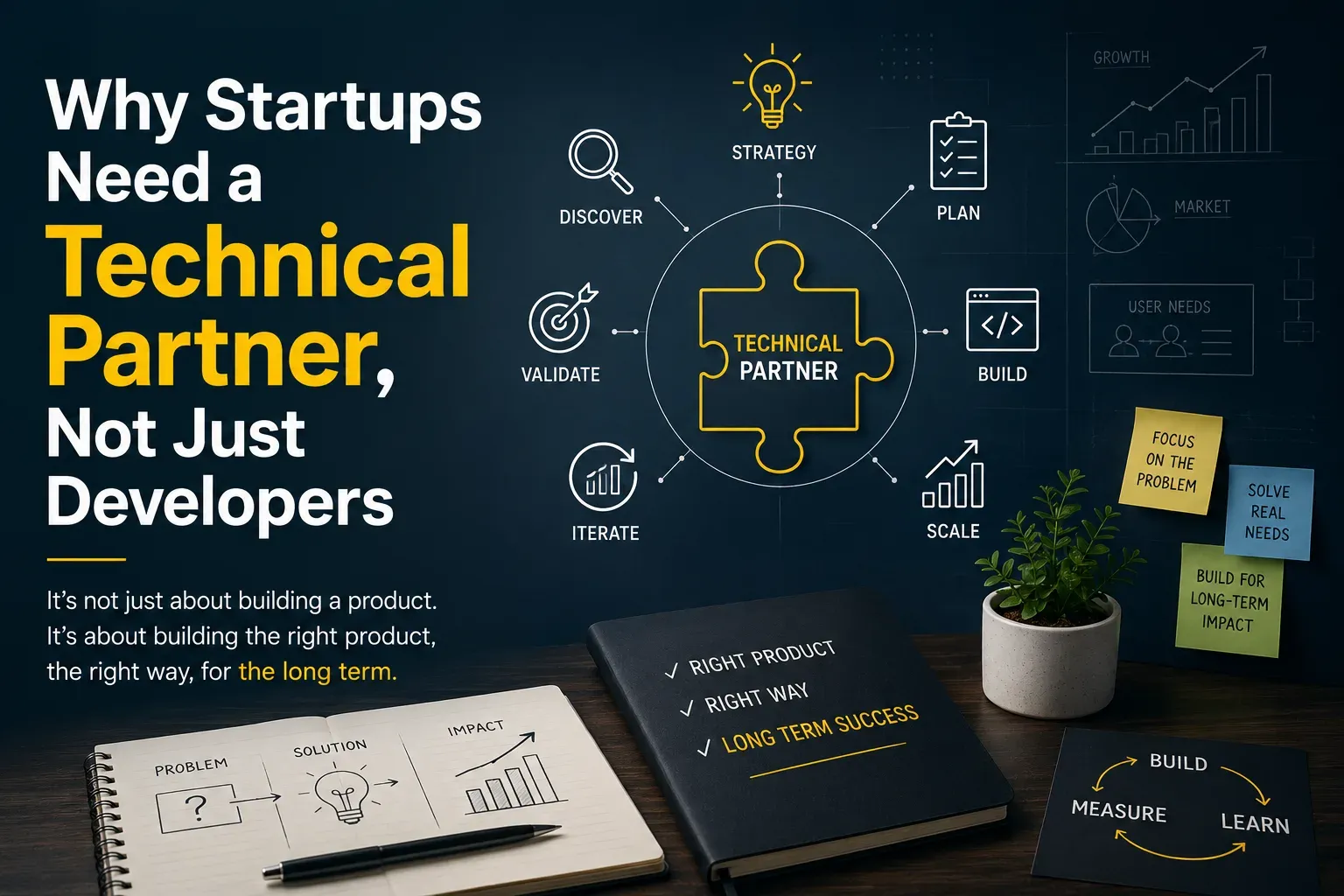
Why Startups Need a Technical Partner, Not Just Developers
Hiring developers can get a product built. Having a technical partner helps ensure you're building the right product, in the right way, for the long term.
A Pattern That Shows Up More Often Than You'd Think
Over the years, I've noticed a pattern that repeats itself across startups.
The founder usually arrives with the same frustration. The product exists. Money has been spent. Development is technically complete. Yet every new change feels harder than it should.
A feature that looked simple becomes a multi-week project. Integrations create unexpected problems. Developers hesitate before touching certain parts of the code because nobody is fully confident about what might break.
When we dig into what happened, the answer is rarely that the developers were incompetent. Most of the time, they built exactly what they were asked to build.
The real issue started much earlier. Nobody was responsible for helping the startup decide what should be built, what should wait, what assumptions needed validation, and how the product would evolve after launch.
That's the difference between hiring developers and having a technical partner.
The Misunderstanding That Costs Startups Time and Money
Many founders approach software development as an execution problem.
The thinking is straightforward. Define the idea, hire developers, build the product, launch it, and iterate.
That sounds logical. The problem is that startups rarely operate with complete information.
Customer needs change. Market assumptions prove wrong. Features that felt essential during planning turn out to be irrelevant after launch. Business models evolve. Growth happens in unexpected places.
A development team can execute requirements.
A technical partner helps shape them.
That distinction becomes incredibly important when you're building something for the first time.
Requirements Are Not Product Strategy
One of the most common mistakes founders make is treating a requirements document as a complete product strategy.
A requirements document describes functionality. Product strategy explains why that functionality matters.
I've seen startups spend months refining feature lists without spending enough time validating whether those features solve a meaningful problem.
The best technical conversations often begin with questions that seem unrelated to technology.
Who is the user?
What behavior are we trying to change?
How will we know the product is succeeding?
What assumptions are we making?
What happens if we remove this feature entirely?
Those questions can feel uncomfortable because they challenge decisions that already feel settled. They also save an enormous amount of time and money.
Good Technical Decisions Start With Business Context
One of the clearest signs of a genuine technical partner is what they ask during the first few meetings.
Teams focused purely on delivery often start with technology.
What platform do you want?
Which framework should we use?
What's the timeline?
Technical partners usually start somewhere else.
They want to understand customers, revenue models, operational challenges, growth plans, and business goals.
Technology decisions become significantly easier when business context is clear.
Without context, even good technical decisions become educated guesses.
The Hidden Cost of Building Too Much
Founders almost always want more in version one than they actually need.
That's understandable.
When you've spent months thinking about a product, every feature feels important.
The challenge is that early-stage startups don't need certainty. They need learning.
An MVP exists to answer questions.
Will users adopt the product?
Will they return?
Will they pay?
What problem matters most?
A technical partner helps identify the smallest version of the product capable of generating meaningful answers.
That discipline often creates more value than writing additional code.
Architecture Matters More Than Most Startups Realize
Startups don't need enterprise-grade systems on day one. They do need thoughtful decisions.
I've seen products struggle because early architecture was designed exclusively around launch deadlines. Nothing appeared wrong initially.
Problems surfaced months later when the company needed new features, new integrations, additional team members, or increased traffic.
The goal isn't overengineering.
The goal is avoiding decisions that create unnecessary limitations later.
Good architecture creates flexibility.
Bad architecture creates friction.
The difference becomes visible as the company grows.
What Happens When Growth Arrives
One of the most expensive moments in a startup's journey often comes after success.
Funding arrives.
Customer numbers increase.
The team expands.
New engineers begin evaluating the platform.
Sometimes they discover a clean foundation.
Other times they discover years of accumulated shortcuts.
At that stage, leadership faces difficult choices. Slow product development to rebuild core systems or continue scaling on infrastructure that wasn't designed for growth.
Neither option is particularly attractive.
Many of those situations can be traced back to decisions made during the earliest stages of development.
How to Identify a Real Technical Partner
The easiest way to identify a technical partner is to observe how they behave before any contract is signed.
Do they challenge assumptions?
Do they explain tradeoffs?
Do they ask difficult questions?
Do they push back when something doesn't make sense?
Do they discuss outcomes instead of simply discussing deliverables?
Strong partners are comfortable disagreeing when necessary.
Their responsibility extends beyond building software.
They're helping shape decisions that affect the business long after the initial release.
Final Thought
Every startup needs developers.
That part is obvious.
The more important question is whether someone is helping guide the decisions that happen before development begins.
Products rarely fail because code was written incorrectly.
More often, they struggle because important assumptions were never challenged, priorities were never clarified, or long-term consequences were never considered.
Developers build products.
Technical partners help startups build businesses.
For founders, that distinction becomes more valuable with every stage of growth.

 Valnee