How to Validate a Startup Idea Before Spending Money on Development
Learn how to validate your startup idea before writing a single line of code. Discover practical frameworks to test market demand and minimize risk.
Summary
Building a software product involves significant financial and operational risk. Many founders rush into development only to realize that the market does not want what they built. This guide provides a practical framework to validate your startup idea before committing capital to engineering. We examine how to define your core assumptions, conduct interviews that yield honest data, and build non-technical MVPs to verify demand. By following these steps, you protect your capital and ensure that your eventual startup software development process targets a proven, paying market.
Blog Content
Every year, we see founders make the exact same mistake. They get a great idea, write a list of features, and immediately look for a technical partner to start building. They spend thousands of dollars and months of work. Then they launch, and nobody cares.
The problem is rarely the code. The problem is that they built something nobody actually needed.
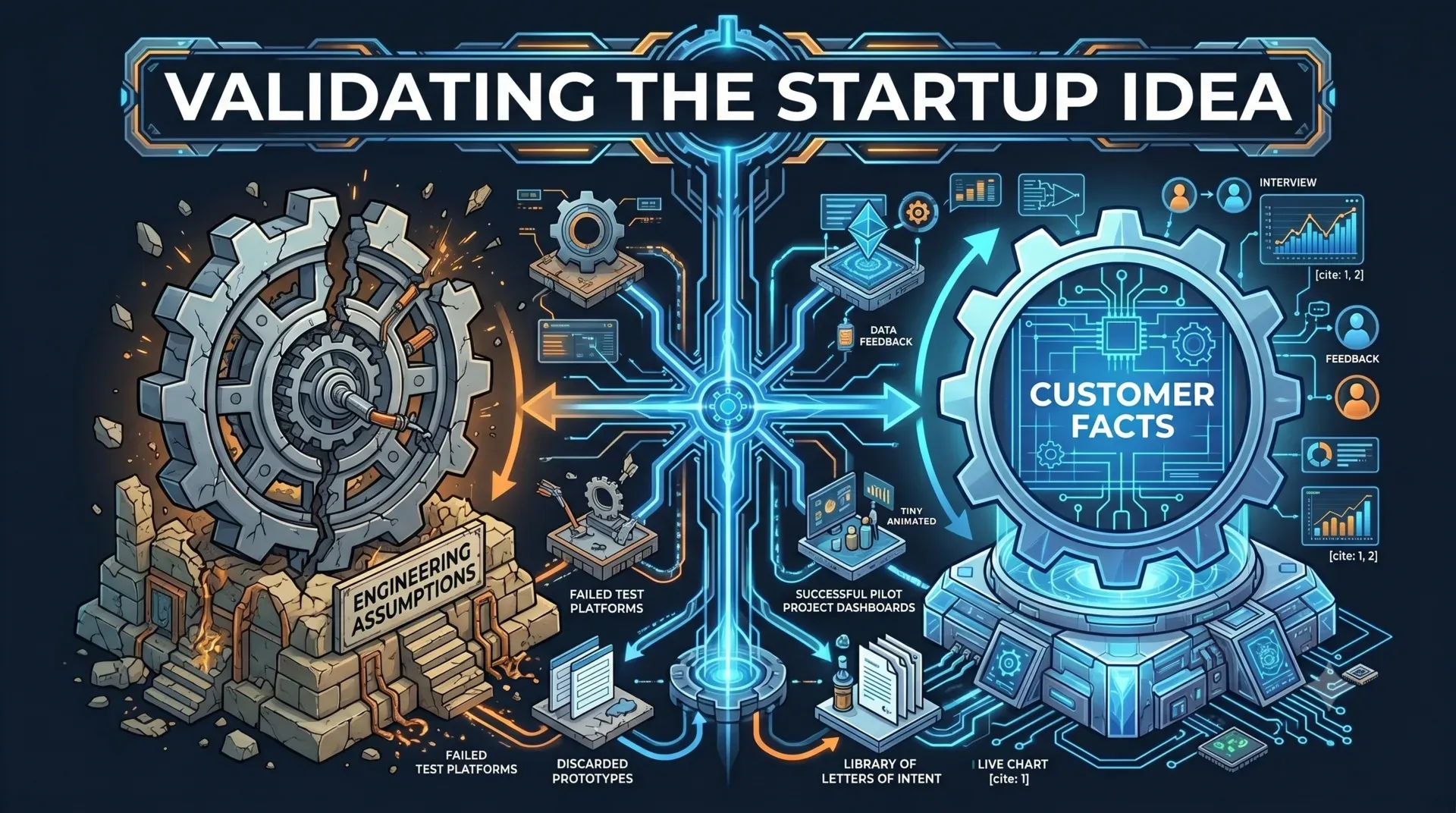
Validating your idea before you spend money on development is how you survive. At Valnee, we guide businesses through tech choices. We always tell founders the same thing: validation must come first, engineering comes second. This guide shows you how to test your concept using real market data before you pay for building.
The Cost of Premature Scaling
Building software costs a lot of money. Changing a product after the code is written is very hard and very expensive. Rushing into development drains your cash fast.
When you build without checking the market, you build on guesses.
- You guess people have the problem.
- You guess they want your specific fix.
- You guess they will pay you for it.
If any of those guesses are wrong, you waste your budget rewriting software. Validation moves the risk out of the way. It lets you make mistakes on paper or simple web pages where fixing things costs nothing. You save your money for when you know exactly what the market wants.
Step 1: Isolate Your Killer Assumption
Every business idea relies on one big guess. If this guess is wrong, the whole business dies. You must find this guess before you do anything else.
Let us look at an app idea. Imagine an app that connects local mechanics with car owners for fast roadside fixes.
The Split Risk Framework
| Type of Assumption | What It Means | Risk Level |
|---|
| Technical Assumption | Can we build a map app with real-time tracking? | Low (Code can almost always do this) |
| Market Assumption | Will drivers trust an unknown local mechanic during an emergency? | High (This is the Killer Assumption) |
If drivers prefer a trusted, famous towing brand during an emergency, your app fails. Find your own killer assumption. Spend 100% of your time testing that exact point.
Most founders do customer research the wrong way. They ask leading questions. This forces people to be nice instead of honest.
If you ask your friends, "Would you use an app that fixes X?" they will say yes to support you. That data is useless. Instead, you must ask about what they did in the past.
Good Questions vs. Bad Questions
| Bad Question (Gathers Opinions) | Good Question (Gathers Facts) |
|---|
| Do you think this is a good idea? | How do you currently solve this specific problem? |
| Would you pay $20 a month for this? | What did you spend last month trying to fix this? |
| What features would you want? | Walk me through the last time this issue occurred. |
Look for pain that people already spend money to fix. If they use a messy mix of Excel sheets and manual emails right now, they have real pain. If they have done nothing to fix it, the problem is not big enough. Do not build software for it.
Step 3: Smoke-Test the Demand
You do not need an engineering team to test clicks or email sign-ups. Smoke-testing means creating the look of a product to see if people actually want it.
The Landing Page Test
Build a basic, clean web page using tools like Framer or Webflow. State your value clearly. Write down exactly what your product will do. Put a big "Get Early Access" or "View Pricing" button on the page.
When a user clicks that button, show a clear message: "We are letting users in using batches. Enter your email to join the waitlist."
Drive 1,000 targeted visitors to that page using basic ads or direct outreach. If nobody signs up, you just saved your whole budget. The market gave you an answer.
The Wizard of Oz Technique
This means you keep the front of the app looking automatic, but you do all the work manually behind the scenes.
When the founders of Zappos started, they did not build a giant warehouse system. The founder went to local shoe stores and took photos of shoes. He put the photos on a basic website. When someone bought a pair, he ran to the store, bought them at full price, and mailed them.
The website looked like a huge online store. The back end was just a person running down the street. Use manual work to check if people want the service before you write code to automate it.
Step 4: Secure Financial Commitment
The best validation is money. A user saying "I would buy that" means nothing. A user giving you cash means everything.
Try to get pre-sales or letters of intent (LOIs).
- If you sell to businesses (B2B): Ask for a signed paper. It should state that if you build the software to fix their issue within 90 days, they will buy a one-year paid contract. Review our previous client outcomes for B2B software validation to see this framework in action. Refer to standard frameworks on the Harvard Business Review for structuring early corporate partnerships.
- If you sell to regular consumers (B2C): Offer a cheap pre-order price. If people will not give you money now for a cheap future fix, they will not give you money later when it is full price.
Setting Up for Startup Software Development
Once you have interviews showing deep frustration, a waitlist of users, and real pre-orders, you are ready to build.
Now, your technical plan is not a guess. You know exactly what features the market wants. This lets you build a tight, clean Minimum Viable Product (MVP). You avoid wasting money on extra features because your users already told you what fixes their pain.
When you start the phase of startup software development with this data, your work with your tech partner changes. You are not asking them to help you find out what to build. You are asking them to build a proven solution fast and safe. For more details on managing early engineering cycles, review the startup guides on Y Combinator.
Frequently Asked Questions
How much money should I spend on validating an idea?
You should spend very little to no money. Validation uses your time for interviews and free or cheap tools for landing pages. Do not spend capital on custom code during this phase.
How many customer interviews are enough?
Aim for 15 to 30 deep interviews with people who fit your exact target user profile. If you start hearing the same answers over and over, you have enough data to find a pattern.
Can I use validation to get startup software development funding?
Yes. Investors prefer startups with real proof. Showing a waitlist of users, interview data, or pre-orders makes it much easier to raise money for development.
Key Takeaways
- Test behavior, not opinions: Base your validation on what potential customers currently do and spend, not on their polite promises about the future.
- Isolate the core risk: Identify the single assumption that could break your business model and design your initial tests exclusively around it.
- Fake the automation early on: Use manual processes and simple landing pages to confirm market demand before hiring engineers.
- Seek financial validation: Prioritize email sign-ups, pre-orders, and letters of intent over casual compliments to ensure your development budget targets a paying market.

 Valnee