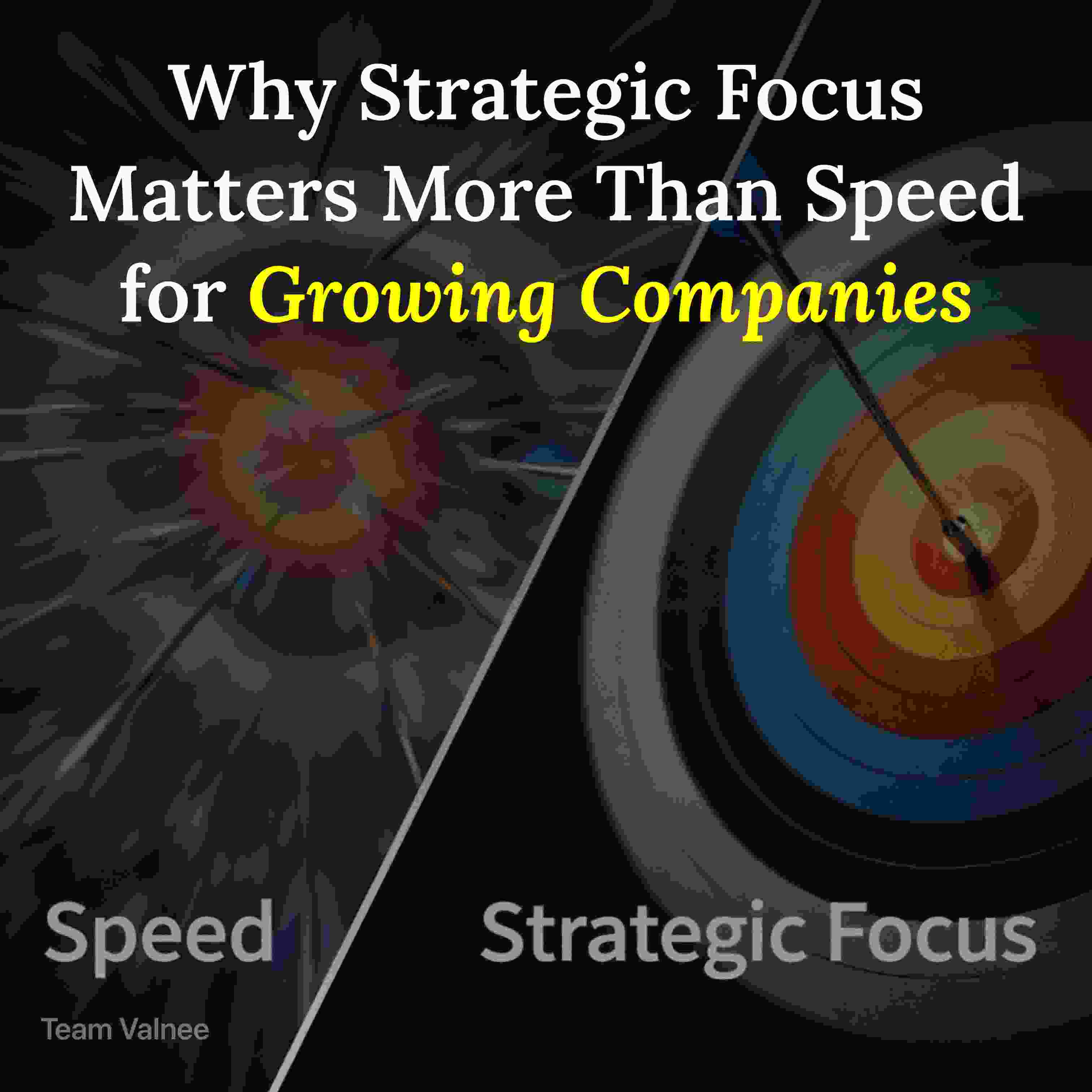
Strategic Focus: The Quiet Force Behind Meaningful Speed
In the world of growing companies, speed is celebrated almost to the point of mythology. Founders brag about how quickly they launched, how fast they scaled, how rapidly they shipped features. Investors praise acceleration. Teams internalize urgency as proof of progress. Speed becomes a badge of honor.
But behind the scenes, many of the companies moving the fastest are also the ones losing the most clarity. They confuse motion with direction. They assume more activity equals more growth. And in the process, they scatter their energy across too many initiatives, too many markets, too many experiments, and too many promises.
What begins as enthusiasm often becomes dilution. The company grows outward faster than it grows inward, stretching itself thin and eventually losing the very focus that could have made it unbeatable.
The Cost of Doing Everything
Strategic focus is the discipline of choosing what not to pursue, even when opportunities seem appealing. It is the understanding that resources — time, energy, capital, engineering bandwidth, customer attention — are finite.
When growing companies attempt to do everything, they inevitably weaken the few things they could have done exceptionally well. This pattern repeats across industries. Teams chase trends, respond to every customer request, build features that dilute the core product, and attempt to capture every segment instead of dominating one.
The result is a widening gap between intention and execution. Case studies across high-growth startups consistently show that scattered execution correlates with rising operational inefficiency and declining product clarity (source –). The team becomes exhausted, and the roadmap becomes unrecognizable.
Speed Driven by Fear
The pressure to move quickly often comes from fear.
- Fear of missing a market
- Fear of losing momentum
- Fear of being overtaken
But speed driven by fear leads to reaction, not strategy. Companies begin responding to external forces instead of defining their own path. They say yes too often. They accept partnerships that don’t align. They chase large enterprise deals that require custom features. They experiment in adjacent markets without mastering their primary one.
These choices feel productive in the moment. They create noise, activity, meetings, prototypes, and announcements. But beneath the surface, the company becomes less stable. The core offering becomes harder to define. The team becomes less aligned. Growth becomes less predictable.
Depth Creates Durability
In contrast, companies that prioritize focus understand that depth creates durability.
They commit to mastering one market before entering another. They refine their product until it becomes undeniably strong for a specific audience. They resist the urge to expand prematurely. They choose simplicity over chaos, clarity over distraction, and long-term positioning over short-term excitement.
Historical examples show that companies that protect their core offering achieve higher customer loyalty and more sustainable revenue trajectories (source –). They refine what works instead of chasing what might work. They spend more time improving their strengths than reacting to competitors. And because of that, they build brands that customers immediately understand.
Focus and Product Identity
Focus also shapes product identity.
Products that try to be everything become nothing identifiable. They lose sharpness. Users can’t articulate what makes them unique. Features become a patchwork instead of a coherent experience. Teams have difficulty deciding what to prioritize because everything seems important.
As the roadmap expands in multiple directions:
- Complexity rises
- Maintenance overhead increases
- Technical debt accumulates
- Innovation slows
Eventually, the company becomes trapped by the weight of its own ambition.
Focus Fuels Velocity
Strategic focus solves this problem by reducing noise.
When a company defines its core value and concentrates its efforts on amplifying that value, clarity emerges. The roadmap becomes cleaner. The messaging becomes sharper. The product becomes simpler. Teams regain alignment.
Momentum becomes easier to sustain because the company is no longer pulled in ten different directions. Focus fuels velocity by eliminating unnecessary work. Counterintuitively, companies that focus more deeply often move faster because they stop wasting time on things that do not matter.
Customer Trust and Memorability
One of the most overlooked advantages of focus is its impact on customer psychology.
Customers trust companies that are easy to understand. They are more likely to adopt products that communicate a specific promise clearly. When a company spreads itself across too many use cases, customers become uncertain about what the product is truly for.
But when a company stands for one thing consistently, customers feel confident. Case examples show that focused companies see:
- Higher retention
- Higher referral rates
- Stronger market positioning
(source –)
Focus makes a product memorable. Speed alone does not.
The Discipline of Saying No
The discipline of saying no is central to maintaining focus.
Growing companies are constantly presented with opportunities that look tempting on the surface but are dangerous beneath it:
- A large customer demands custom features
- An adjacent market requires reworking the core product
- A competitor launches a feature that feels urgent to copy
Teams convince themselves these deviations are small or temporary. But every deviation costs something — time, attention, momentum, or coherence. Over time, these small compromises accumulate into strategic drift.
Saying no protects the company’s identity. It preserves team energy. It prevents the roadmap from fracturing under pressure. It requires confidence, patience, and a willingness to sacrifice short-term gains for long-term clarity.
Focus as an Operational Advantage
Strategic focus also creates operational efficiency.
When teams know exactly what matters:
- Decisions happen faster
- Meetings become shorter
- Engineering becomes cleaner
- Marketing becomes sharper
- Customer support improves
The organization feels lighter and more aligned. Speed increases — not chaotic speed, but purposeful speed. Speed supported by clarity instead of anxiety.
Focused Growth Scales Better
Companies that commit to focused sequencing achieve healthier long-term trajectories.
They build products that become category-defining rather than category-chasing. They deepen expertise instead of diluting it. They attract customers who instantly understand their value. They earn trust by delivering consistently.
They scale with structure, not improvisation.
Conclusion: Speed With Intention
In the end, speed matters only when it is supported by direction.
Movement without clarity is noise. Movement with clarity is progress. The most successful companies are not those that move the fastest, but those that move with the greatest intention.
Strategy is not about doing more. It is about doing what matters with precision.
Focus creates the foundation upon which speed becomes valuable. Without it, speed is nothing more than motion.
The companies that endure — the companies that build deep moats and become market leaders — all share the same habit:
- Focus over frenzy
- Depth over breadth
- Clarity over chaos
Strategic focus is not the opposite of speed. It is the requirement for meaningful speed. It is the quiet force behind every company that scales with strength, stability, and purpose.